


low fade vs mid fade vs high fade Picking a fade haircut sounds simple until you’re actually sitting in the barber’s chair and someone asks, “low, mid, or high?” Each option changes the height, contrast, and overall vibe of your cut, and choosing the wrong one can throw off your whole look. Knowing the difference ahead of time puts you in control of the conversation.
This guide breaks down exactly where each fade starts, who it suits best, and how much upkeep to expect. By the end, you’ll know precisely what to tell your barber and which fade fits your face shape, hair type, and lifestyle without any of the guesswork.
What Is A Low Fade?
A low fade is the most understated version of the fade haircut. The blend starts just above the ears and tapers gradually down toward the neckline, leaving most of the length on top and sides untouched. Because the transition happens so close to the bottom of the head, the contrast stays soft and the cut reads as clean rather than flashy.
This makes the low fade a go-to choice in offices, courtrooms, and other settings where a conservative appearance matters. It also plays nicely with thicker or curlier hair, since less volume gets removed from the sides. Barbers typically use a clipper guard to soften the taper, then finish the edges with a trimmer for a crisp hairline.
Defining Characteristics of A Low Fade
- Starting point: Just above the ear, near the hairline
- Contrast level: Low to moderate, with a soft blend
- Maintenance: Every 3–4 weeks
- Best hair types: Thick, curly, or wavy hair
- Best for: Professionals, conservative dress codes, first-time fade wearers
- Pairs well with: Side part, comb-over, textured crop, mullet
What Is A Mid Fade?

The mid fade splits the difference between subtle and bold. The fade begins around the temple area, roughly halfway up the side of the head, giving it more visible skin exposure than a low fade while still keeping some restraint. It’s often considered the most versatile of the three because it adapts to nearly any hair texture, face shape, or styling preference on top.
Because the blend sits higher, a mid fade creates noticeably sharper definition than a low fade without tipping into the dramatic territory of a high fade. It works equally well in a corporate office or a weekend setting, which is a big reason it’s become the most requested fade at many barbershops today.
Learn more:2026 Nail Trends: From Clean Girl to Maximalist Sets
Defining Characteristics of A Mid Fade
- Starting point: Around the temples, midway up the side of the head
- Contrast level: Moderate, with clear but balanced definition
- Maintenance: Every 3–4 weeks to keep the line sharp
- Best hair types: Works with straight, wavy, and curly hair
- Best for: Guys who want versatility between polished and edgy
- Pairs well with: Textured crop, quiff, slick back, pompadour
What Is A High Fade?

A high fade is the boldest of the three, with the taper starting well above the temples, sometimes near the crown of the head. This means a much larger portion of the sides is cut short or shaved to the skin, creating a sharp, high-contrast finish that makes the hair on top look fuller by comparison.
Because so much hair is removed from the sides, a high fade demands more frequent touch-ups to keep the line crisp as it grows out. It’s a favorite among men who want a modern, statement-making look, and it pairs especially well with styles that rely on strong contrast, like a disconnected top or an angular design.
Defining Characteristics of A High Fade
- Starting point: Above the temples, close to the crown
- Contrast level: High, with dramatic skin exposure
- Maintenance: Every 2–3 weeks to maintain sharpness
- Best hair types: Works especially well with thick or coarse hair
- Best for: Bold, trend-driven, or younger clientele
- Pairs well with: Pompadour, mohawk, spiky crop, disconnected undercut
Low Fade vs Mid Fade vs High Fade
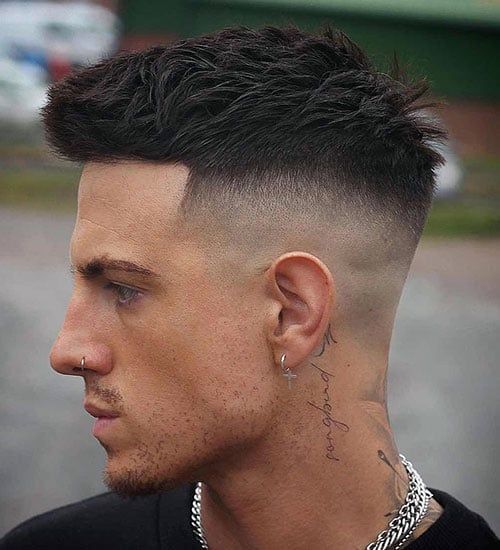
The core difference between these three cuts comes down to one thing: where the fade begins on the head. That single starting point determines how much contrast you get, how often you need a trim, and how dramatic the finished style looks. Here’s a side-by-side comparison to make the choice easier.
| Feature | Low Fade | Mid Fade | High Fade |
| Starting Point | Just above the ear | Around the temples | Above the temples, near the crown |
| Contrast Level | Subtle | Balanced | Dramatic |
| Maintenance Frequency | Every 3–4 weeks | Every 3–4 weeks | Every 2–3 weeks |
| Best For | Professional, conservative styles | Versatile, everyday looks | Bold, trend-forward styles |
| Face Shape Fit | Square, oblong | Most face shapes | Round, oval |
| Styling Effort | Low | Moderate | Moderate to high |
Choosing between them really comes down to how much contrast you want and how much upkeep you’re willing to commit to. If you’re unsure, a mid fade is a safe starting point since it sits comfortably between the other two.
Different Types of Fade Haircuts

Once you’ve settled on the height of your fade, there are a few additional variations worth knowing so you can fine-tune the finished look with your barber.
- Skin Fade – Tapers all the way down to bare skin for maximum contrast and a razor-sharp finish.
- Taper Fade – A gentler, less aggressive version that focuses mainly on the neckline and sideburns.
- Drop Fade – The fade line curves downward behind the ear instead of running straight, adding a distinctive shape.
- Burst Fade – Curves in a semi-circle around the ear, often paired with mullets or mohawks.
- Temp Fade – Focuses the taper around the temples only, leaving the back of the head longer.
- Undercut Fade – Combines a disconnected top with a faded side for a sharper contrast between sections.
Mentioning one of these by name when you sit down for your haircut helps your barber understand exactly how much detail and shaping you’re after.
Frequently Asked Questions
Which fade is the most professional?
The low fade is generally considered the most professional choice because it offers subtle contrast and a polished, conservative finish.
Does a mid fade suit every face shape?
Yes, the mid fade is the most versatile option and complements nearly every face shape and hair texture.
How often do I need to get a fade touched up?
Low and mid fades typically need a trim every 3–4 weeks, while high fades often require touch-ups every 2–3 weeks.
Can I combine a high fade with longer hair on top?
Absolutely. A high fade actually makes longer hair on top look fuller by creating strong contrast with the shorter sides.
Is a skin fade the same as a high fade?
No. A skin fade refers to the hair tapering down to bare skin, while a high fade refers to where the taper begins on the head. They can be combined.
Conclusion
At the end of the day, the right fade comes down to how much contrast you want and how much maintenance fits your routine. A low fade keeps things subtle and professional, a mid fade offers balance for nearly any setting, and a high fade delivers bold, modern impact for those ready to stand out.
Bring this guide to your next barbershop visit and describe the starting point, contrast level, and style you’re aiming for. A skilled barber can then customize the fade further with a drop, burst, or skin finish to match your face shape and personal taste.