

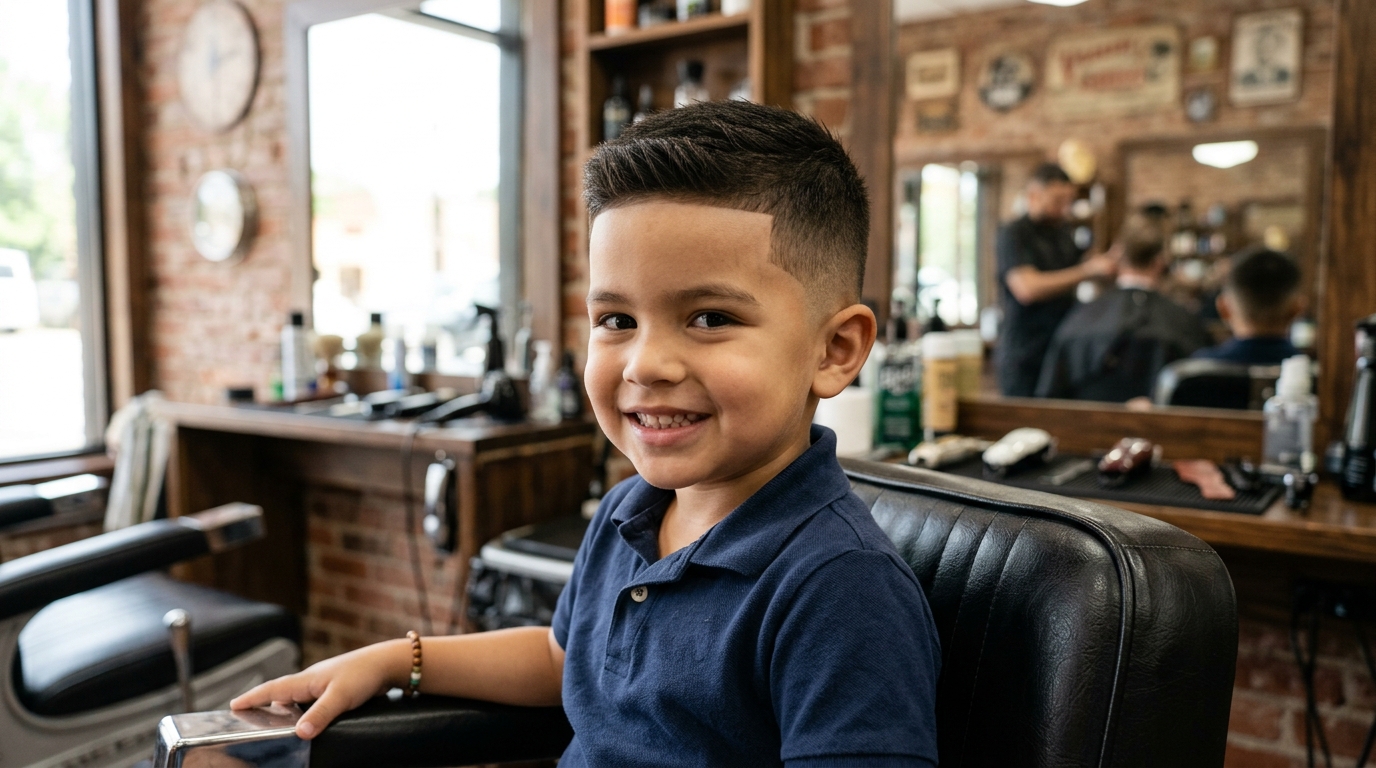
If your son is asking for a “fade” but you want something that still looks age-appropriate and school-safe, the low taper fade is likely the answer. It’s neat, low-maintenance, and flatters almost every hair type and face shape without drawing too much attention.
This guide breaks down exactly what the cut is, how it differs from other fades, which styles work best in 2026, and how to communicate clearly with your barber so your son walks out with the look you both agreed on, not a guess.
What is a low taper fade haircut for boys?
A taper is a gradual shortening of hair as it moves down the head, rather than one abrupt length change. A fade takes that gradual blend and pushes it further, so the transition between lengths is nearly invisible to the eye.
“Low” simply refers to where that blending starts. On a low taper fade, the fade begins close to the ears and along the hairline at the back of the neck, not partway up the sides of the head. This keeps more natural volume around the ears and crown, which is why the style reads as softer and more boyish than a high or mid fade.
For boys specifically, this matters because:
- The lower starting point keeps the cut looking tidy without looking “styled” or overly grown-up.
- It grows out more forgivingly than higher fades, since there’s less contrast between lengths.
- It works on nearly any hair texture without needing daily upkeep.
Why the low taper fade is so popular for boys in 2026
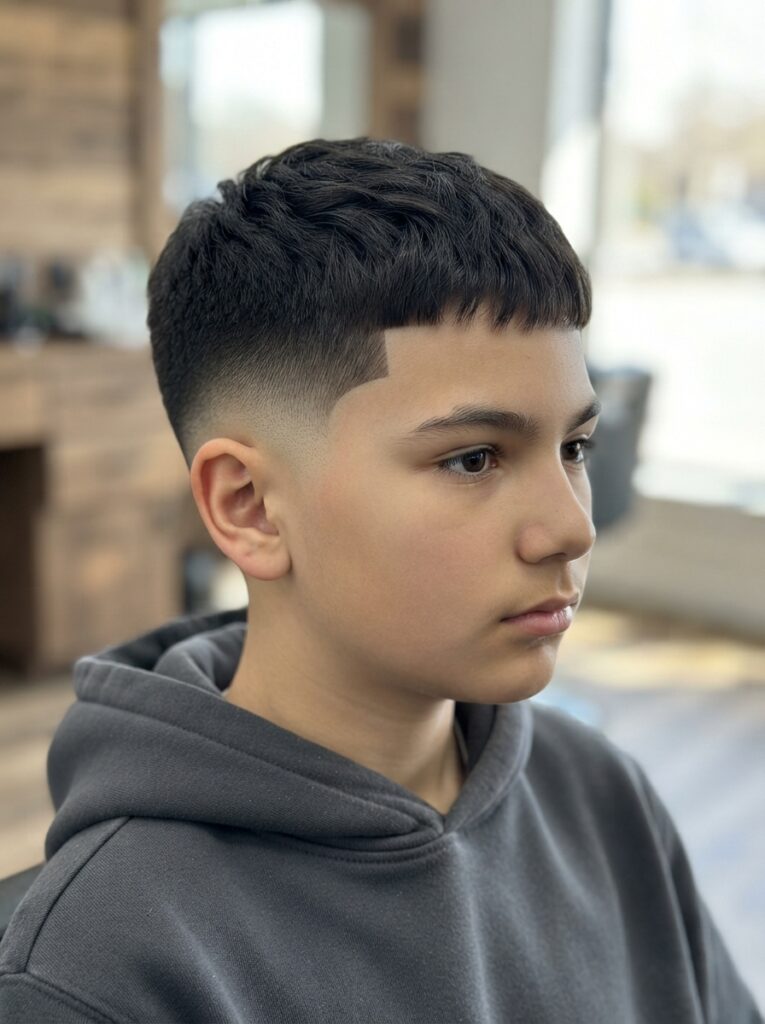
A few practical reasons explain why parents and barbers keep gravitating toward this cut in 2026:
- Low upkeep between visits. Because the blend sits low, regrowth around the ears and neckline is far less noticeable than with a high fade.
- Works with any top style. Curls, a fringe, a side part, or a simple crop all sit comfortably above a low fade, it’s a base, not the main feature.
- Suits younger and older boys alike. It doesn’t read as a “grown man’s” haircut the way a skin fade or high fade sometimes can, making it appropriate for a wide age range.
- Barber-friendly and correctable. Because the blend is gradual and lower on the head, small unevenness is easier for a barber to fix on the next visit.
- Social media influence. Short clips of clean fade transformations continue to circulate widely, keeping demand high among tweens and teens who want a “barbershop” look without anything extreme.
Low taper fade vs regular fade: what’s the difference?
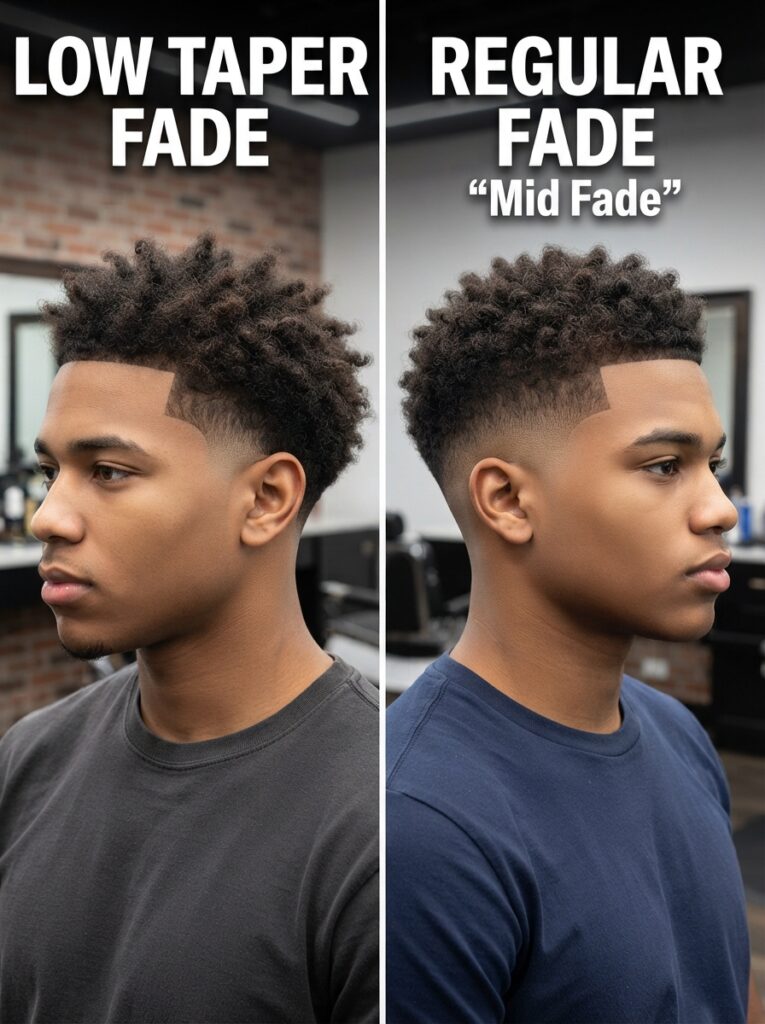
“Regular fade” usually refers to a mid or high fade, where the blending starts higher up the side of the head, sometimes level with the temple or above. This creates a much sharper contrast between the short sides and the longer top.
| Feature | Low Taper Fade | Mid Fade | High Fade |
| Where the blend starts | Just above the ears / neckline | Around temple height | At or above the temple |
| Visual contrast | Soft, subtle | Moderate | Strong, bold |
| Best for | School, younger boys, everyday wear | Boys who want a bit more edge | Teens wanting a statement look |
| Regrowth visibility | Slowest to show | Moderate | Fastest to show |
| Maintenance frequency | Every 3–4 weeks | Every 2–3 weeks | Every 2 weeks |
Learn more:Low Taper Fade Vs Low Fade: What’s The Difference?
For most boys, especially those under school dress codes, the low taper fade is the safer and more versatile choice, it looks tidy without looking dramatic.
Best low taper fade styles for boys
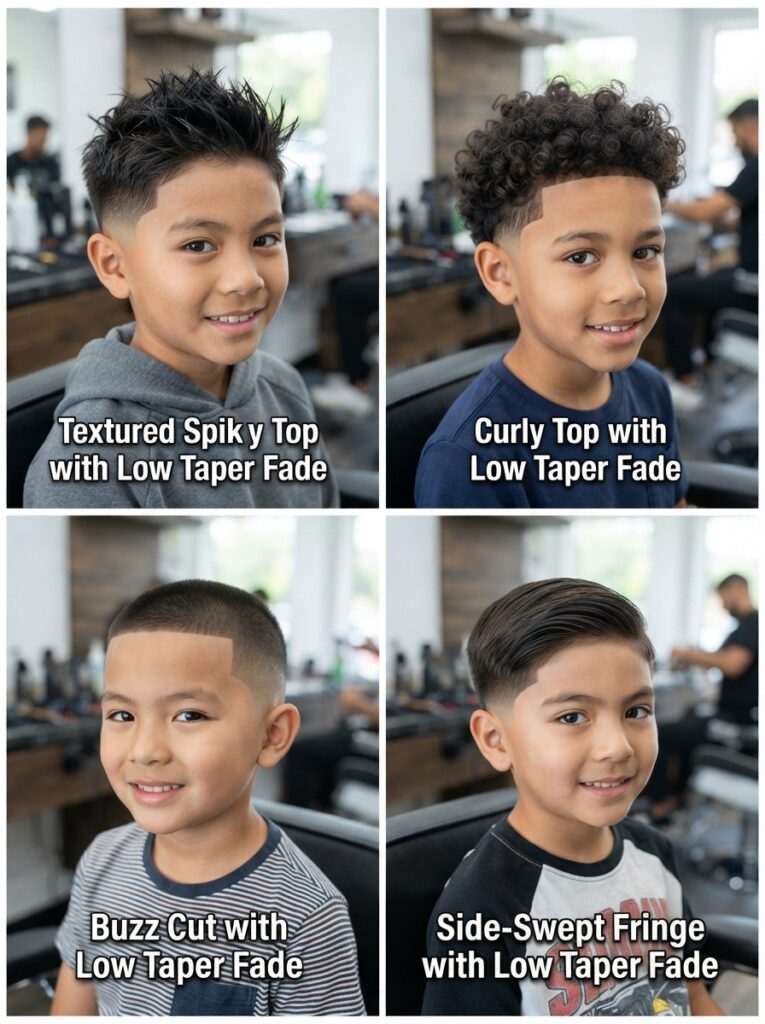
The fade itself barely changes from style to style, what changes is the top. Here are the most popular options going into 2026:
- Textured crop – Medium-length hair on top, worked with light product for natural texture. Works for school and weekends alike with almost no restyling.
- Fringe – Hair swept forward or angled to one side. Suits straight and wavy hair especially well.
- Curly top – The fade keeps the sides controlled while natural curls stay full on top. Low-effort and high-impact.
- Side part – A sharper, dressier option, good for school photos or events.
- Messy top – Slightly longer hair styled loosely; looks relaxed but intentional because the sides stay clean.
- Short crop / buzz on top – The lowest-maintenance option, works well with thick or dense hair.
Choosing a style and products by hair type
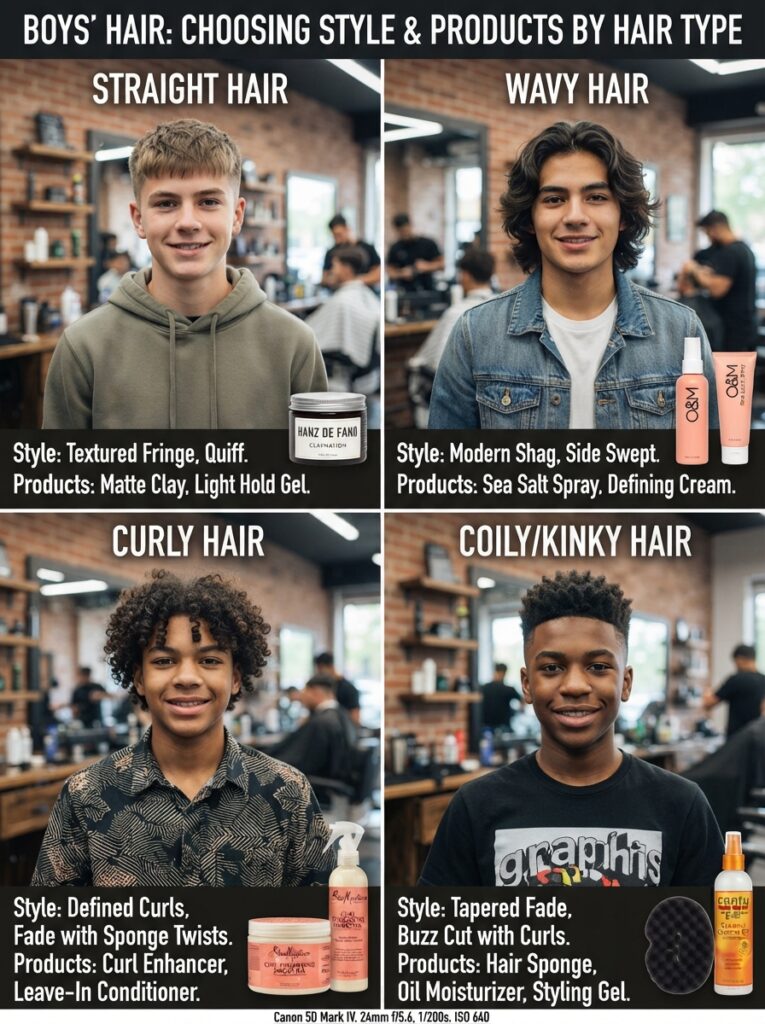
The haircut adapts easily across hair types, what changes is length left on top and the products used to style it.
| Hair Type | Recommended Top Length | Best Products |
| Straight | Short to medium; side part or fringe | Light styling cream, matte pomade |
| Wavy | Medium, left natural | Texturizing cream or sea salt spray |
| Curly | Medium to full, curls left intact | Lightweight curl cream or leave-in conditioner |
| Thick | Medium, may need thinning | Medium-hold cream or light wax |
| Fine | Slightly longer to avoid a sparse look | Volumizing spray or mousse |
For younger boys, less is more, a towel dry, a small amount of product, and a light comb-through is usually enough to keep the cut looking finished.
Which face shapes suit a low taper fade?
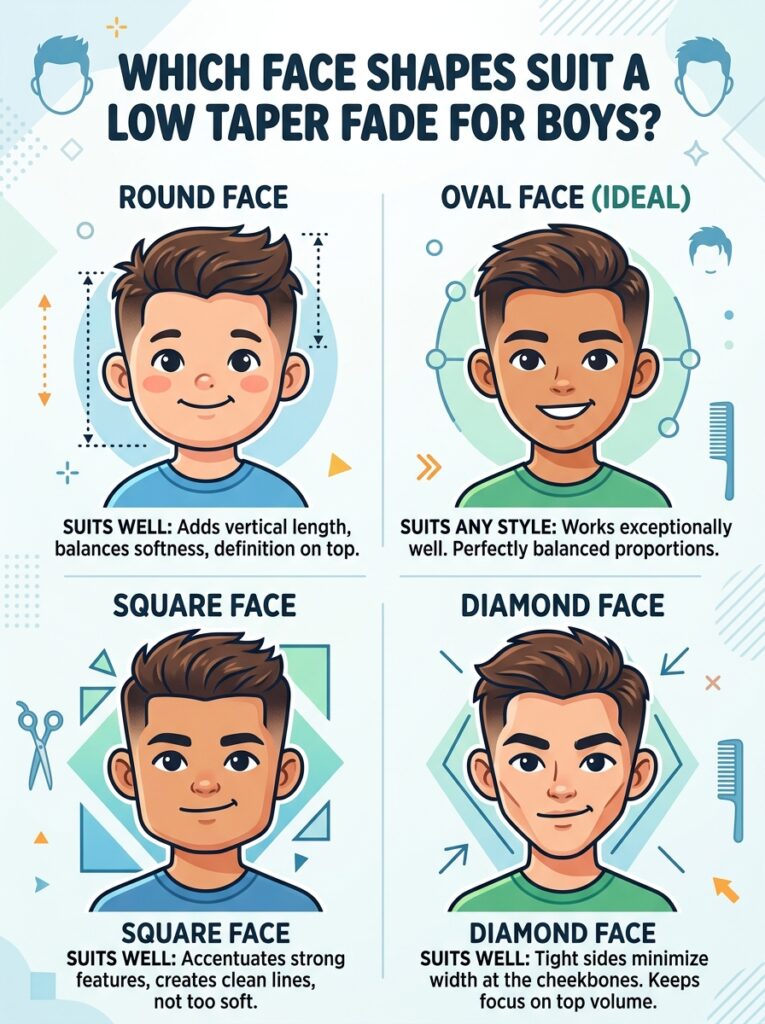
The low taper fade is flexible enough to suit almost any face shape with small adjustments to the top.
| Face Shape | What Works Best |
| Round | Added height or texture on top to elongate the face |
| Oval | Almost any top style works well |
| Square | Medium top with light texture to soften strong jaw and forehead lines |
| Long | Flatter top or a fringe to avoid adding extra length visually |
| Heart-shaped | Fringe or textured top to balance a wider forehead and narrower chin |
These are general guidelines, a skilled barber will always adjust based on the boy’s individual head shape, hair growth pattern, and personal preference.
Keeping it school-friendly
Most schools are comfortable with a low taper fade as long as a few boundaries are respected:
- Keep the fade blending low, near the ears and neckline, avoid it climbing too high.
- Skip shaved lines, patterns, or logos cut into the sides.
- Avoid a full skin fade if the school has a conservative grooming policy; a soft blend to short (not bare) skin is usually safer.
- Choose a manageable top length, very long, face-covering tops can sometimes draw attention from stricter staff.
- Go light on product, a matte finish looks neater for school than a wet or spiked look.
If you’re unsure, it’s worth checking your school’s specific grooming or uniform policy before booking anything more distinctive.
How to ask your barber for a low taper fade
Clear communication makes a big difference in the outcome. A few tips:
- Be specific about placement. Say “low taper fade, blending near the ears and neckline” rather than just “fade”, otherwise a barber may default to a mid fade.
- Describe the top separately. For example, “medium length with some texture” gives the barber far more to work with than “not too short.”
- Mention school requirements if relevant. Phrases like “keep it natural, nothing too sharp” signal a conservative approach.
- Bring a reference photo. It doesn’t need to match exactly, it just needs to convey length, blend, and overall vibe.
Keep in mind that the same photo will look slightly different on every boy, since hair texture, density, and head shape all vary. A good barber adapts the reference to suit those factors rather than copying it exactly.
How often do boys need a trim?
A low taper fade looks its sharpest in the first one to two weeks. After that, regrowth pace depends on the individual.
| Hair Growth Rate | Recommended Trim Frequency |
| Average | Every 3–4 weeks |
| Fast-growing / thick hair | Every 2–3 weeks |
| Curly hair | Every 2–3 weeks (grows outward as well as down) |
| Longer top styles | Can stretch slightly longer between trims |
A longer top generally buys extra time between visits, since the added length blends more forgivingly as the sides grow out. A short crop shows regrowth fastest since the contrast is more obvious.
Common mistakes to avoid
- Not saying “low.” Leaving this out often results in a higher, sharper fade than intended.
- Cutting the top too short. A textured or curly top needs enough length to actually style.
- Copying a style that doesn’t match the hair type. What looks great on thick hair may not translate to fine or curly hair.
- Overusing product. A small amount goes a long way, especially on younger boys.
- Expecting an exact match to a photo. Reference images are a guide, not a guarantee, lighting, hair density, and texture all affect the final result.
The bottom line
The low taper fade earns its popularity by being genuinely practical: it’s neat enough for school, current enough for boys who care about their look, and low-maintenance enough for parents managing busy schedules. It adapts to nearly any hair type, face shape, and personal style on top.
Frequently Asked Questions
Is a low taper fade good for boys?
Yes, it’s one of the most versatile and age-appropriate fades available, working well for school, everyday wear, and special occasions across most hair types.
Is a low taper fade allowed in school?
Generally yes, since it reads as tidy rather than bold. Always check your specific school’s grooming policy before adding shaved designs or a full skin fade.
How long does a low taper fade last?
It looks freshest for one to two weeks, with most boys needing a trim every three to four weeks to keep it sharp.
What should I tell my barber for a low taper fade?
Ask specifically for a “low taper fade near the ears and neckline,” describe the top length and style you want, and bring a photo if possible.
Does a low taper fade work for curly hair?
Yes, it’s especially effective on curly hair, since it controls the sides while letting natural curls stay full on top.