

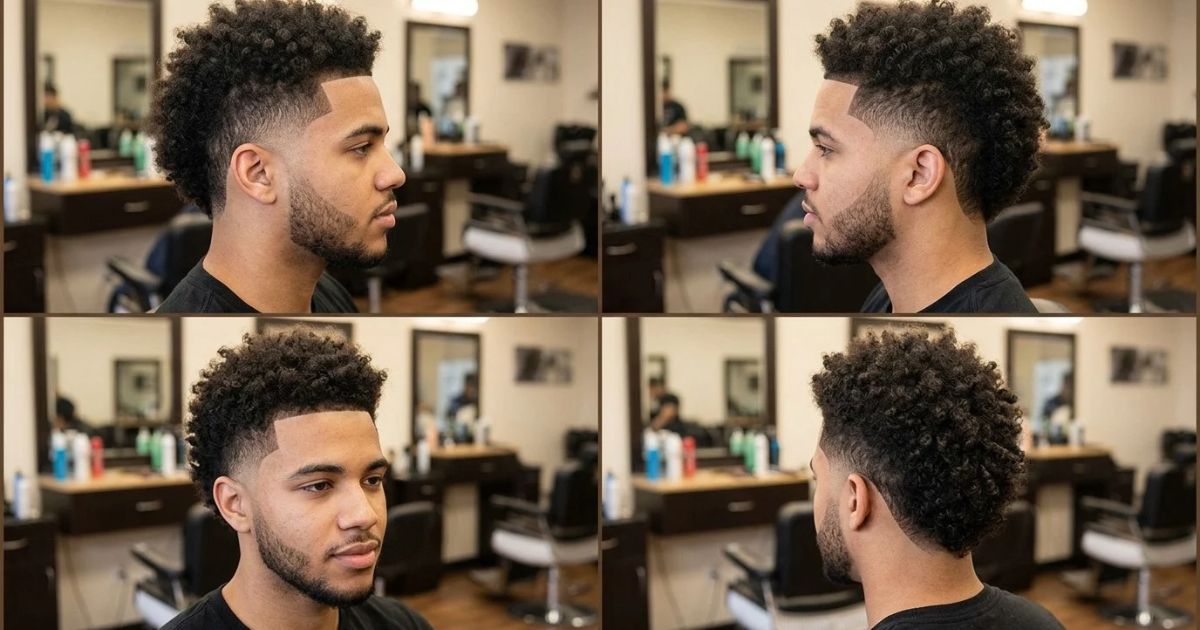
Burst fade for curly hair curves in a rounded arc around the ear, then blends into the neckline. On curly hair, that shape trims side bulk while your curls keep their length on top. It suits waves, curls, and coils, but in practice the same name can describe very different haircuts.
This guide shows how to choose the right height, finish, and top style for your curl type. You will also get a barber script, daily styling steps, wash-day care, grow-out tips, and fixes for common problems, so you can walk into the chair knowing exactly what to ask for.
What is a burst fade on curly hair?
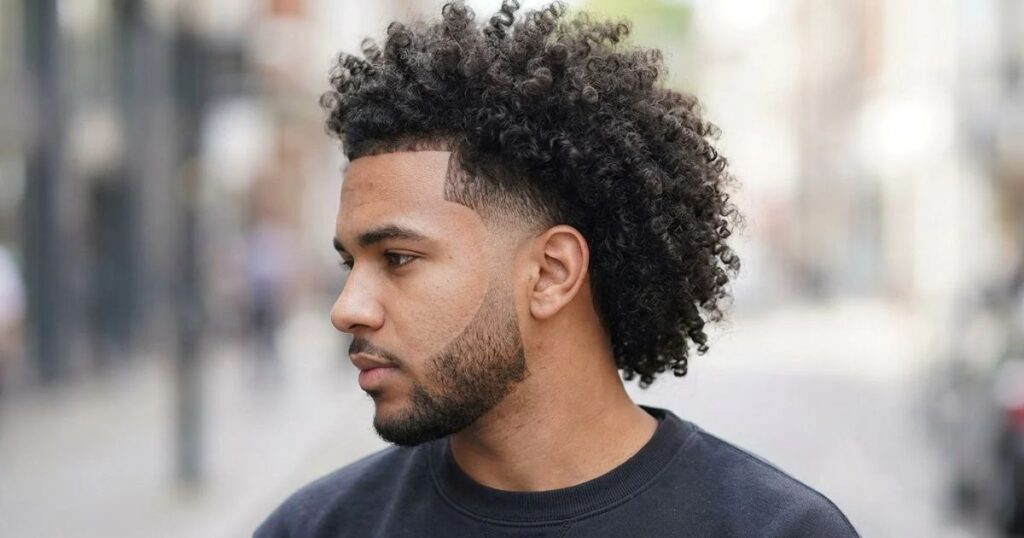
A burst fade on curly hair is a haircut where the fade follows a curved arc around and behind the ear instead of running straight down the side of the head. The curls above stay as long as you like. The arc simply removes weight from the sides and sets up a clean frame.
Think of the name as describing the path of the fade. It does not tell you how high the fade starts or how short it ends. Those are separate choices.
Which parts of the haircut can be customized?
Six details change how a burst fade looks. Naming each one to your barber works better than pointing at a single photo.
| Detail | What you decide |
| Fade height | Low, mid, or high starting point |
| Finish | Bare skin, zero guard, shadow, or a short guard |
| Arc width | A tight curve near the ear or a wider sweep |
| Side weight | How much hair stays just above the arc |
| Top shape | Cropped coils, rounded curls, fringe, or extra volume |
| Back and neckline | Natural, tapered, blocked, or left long |
Why does the burst shape work with curls?
Curly and coily hair grows outward, so side bulk builds up fast. A burst fade removes that bulk around the ear without flattening the whole side of your head. The curve also looks softer than a straight fade line, which helps it blend with natural texture.
It is not automatically low maintenance, though. A crisp arc with a skin finish shows regrowth sooner than a soft shadow finish.
Learn more:Medium Length Hairstyles for Women: 20 Trendy Haircut Ideas for 2026
Will a burst fade suit your curls?
For most people, yes. The cut adapts to loose waves, defined curls, and tight coils by changing the height, the finish, and the weight left above the arc. Instead of asking “Is my curl type allowed?”, ask “Which version fits my hair and my routine?”
What hair factors matter most?
Curl label matters less than how your hair actually behaves. Ask your barber to look at it dry and in its natural state.
| Hair factor | Why it matters |
| Density | Thick hair carries a wider or higher arc well. Thinner hair needs more weight left on the sides. |
| Strand thickness | Fine strands show scalp sooner at the same guard length. |
| Shrinkage | Curls can dry much shorter than they look wet or stretched, so the top is often left longer. |
| Growth direction | Crown swirls and cowlicks decide where the arc can blend cleanly. |
| Chemical treatment | Relaxed, permed, or color-treated hair may react differently to clippers and styling. |
What face, head-shape, and lifestyle factors matter?
Head shape and upkeep matter more than strict face-shape rules. A higher arc adds contrast and height. A lower one stays tidy longer and grows out more gently.
Consider these before you book:
- The shape of your crown and the back of your head
- How long you want your neckline to stay clean
- Whether your school or workplace has grooming rules
- How often you can realistically visit a barber
- Skin sensitivity around the ears and nape
Should you choose a low, mid, or high burst fade?
Low, mid, and high describe where the fade starts on the side of your head. They do not describe how short it ends. Low starts near the ear, mid starts about halfway up the side, and high starts near the temple or above.
| Feature | Low burst fade | Mid burst fade | High burst fade |
| Starting point | Just above the ear | Between ear and temple | Near the top of the sides |
| Contrast | Subtle | Balanced | Strong |
| Side weight kept | Most | Moderate | Least |
| Grow-out | Softest | Moderate | Most noticeable |
| Best for | First-timers, office settings | Everyday wear, most curl types | Thick curls, bold looks |
Quick pick: choose low for easy upkeep, mid for the best balance, and high when you want the fade itself to be part of the look. If you are unsure, start low. Hair can be taken higher next time, but it cannot be put back.
Which curly burst fade style should you show your barber?
Choose by silhouette, retained length, and finish rather than by style name. Bring one side photo and one rear photo for every look you like.
Which options look subtle and grow out softly?
These keep more hair around the ear, so the transition looks gradual even a few weeks later.
Low shadow burst fade
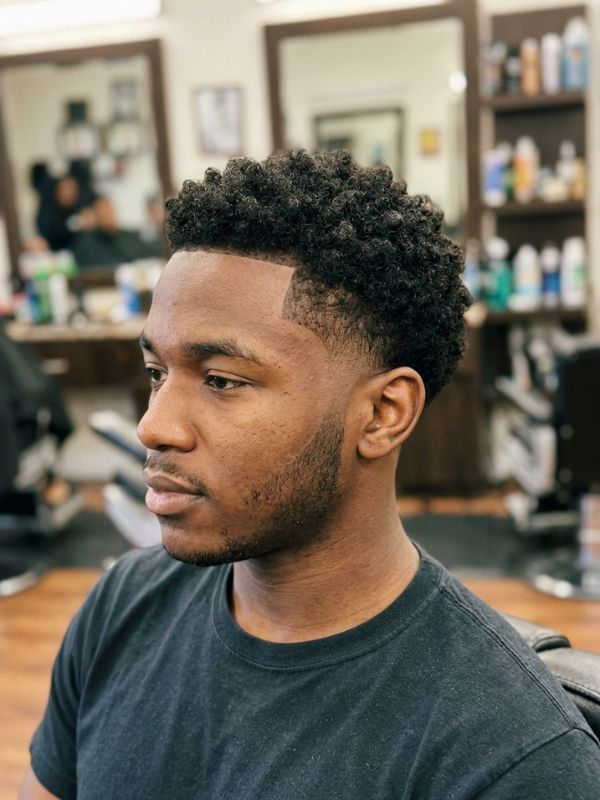
The arc sits close to the ear and ends in a shadow of very short hair instead of bare skin. It looks polished without a harsh contrast line, which makes it a safe starting point.
Low burst fade with short curls or cropped coils
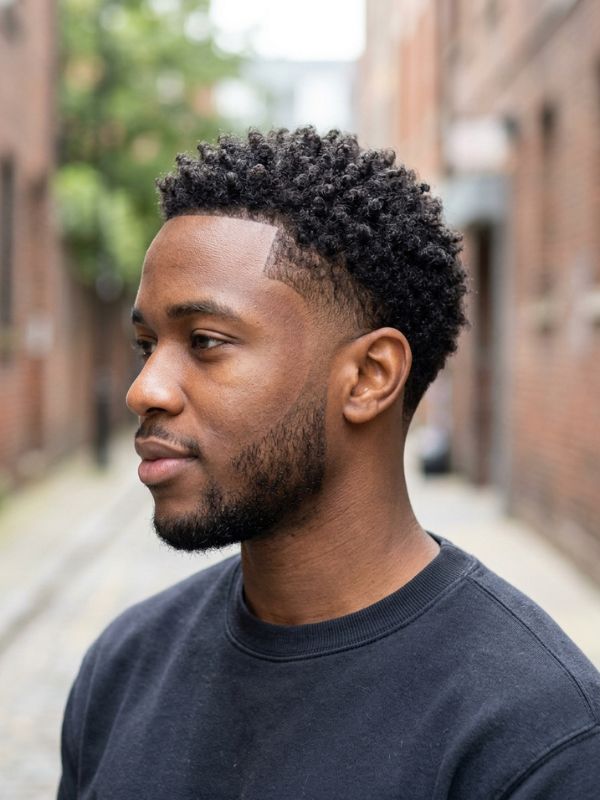
Short curls or cropped coils on top keep the silhouette compact. Upkeep focuses on the top shape, since the low arc changes slowly.
Low burst fade with a natural or tapered neckline
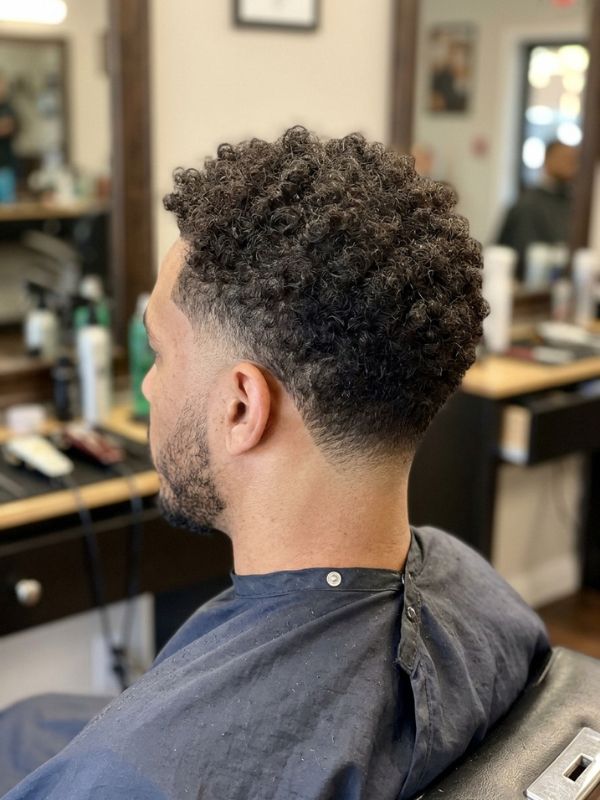
The back is left natural or lightly tapered instead of cut into a hard edge. With no sharp line to protect, the outline grows out without looking messy.
Which options balance contrast and everyday versatility?
A mid placement gives clear shape without the upkeep of a very high fade. It is a reliable default for most curl types.
Mid burst fade with defined curls or coils
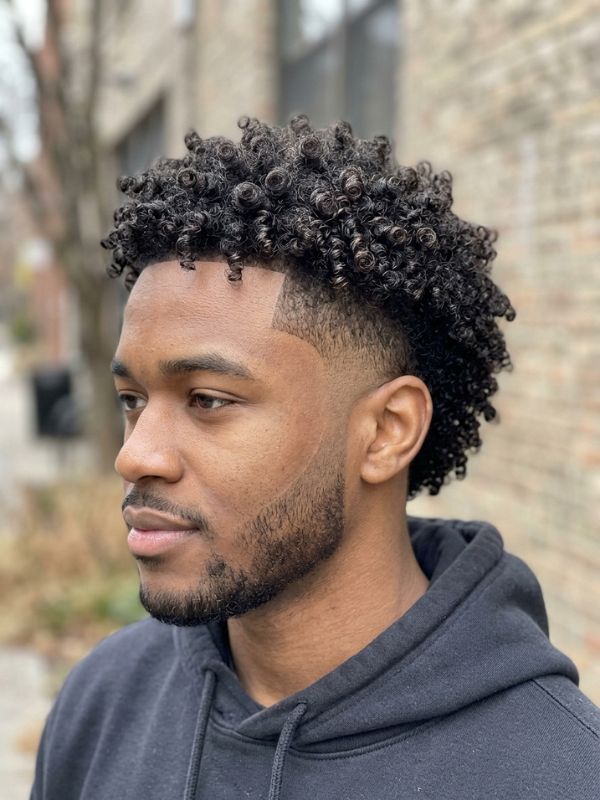
Contrast comes from texture as much as from length. Defined curls or coils sit above a clean arc, which reads as sharp but still relaxed.
Burst fade with curly fringe
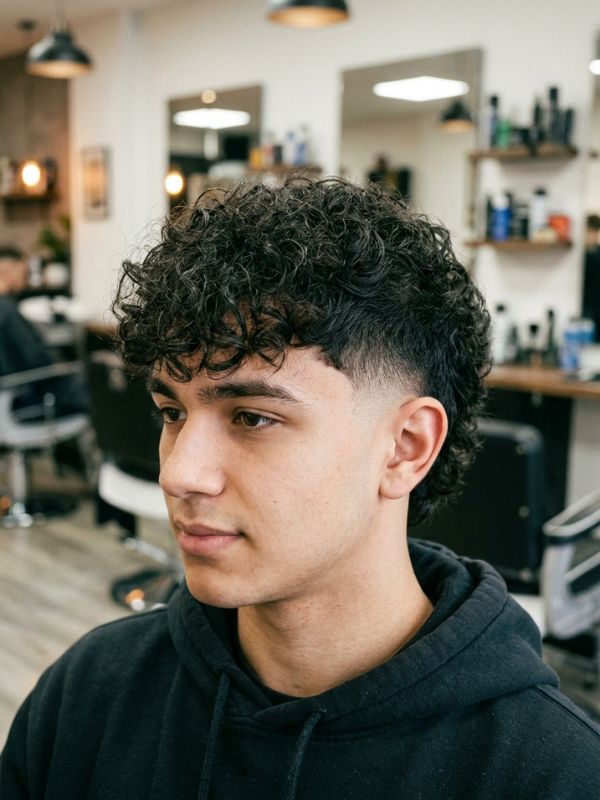
A longer front section falls forward while the sides stay controlled. Ask your barber to leave enough length for the fringe to curl naturally after it dries.
Mid burst fade with a rounded curly top
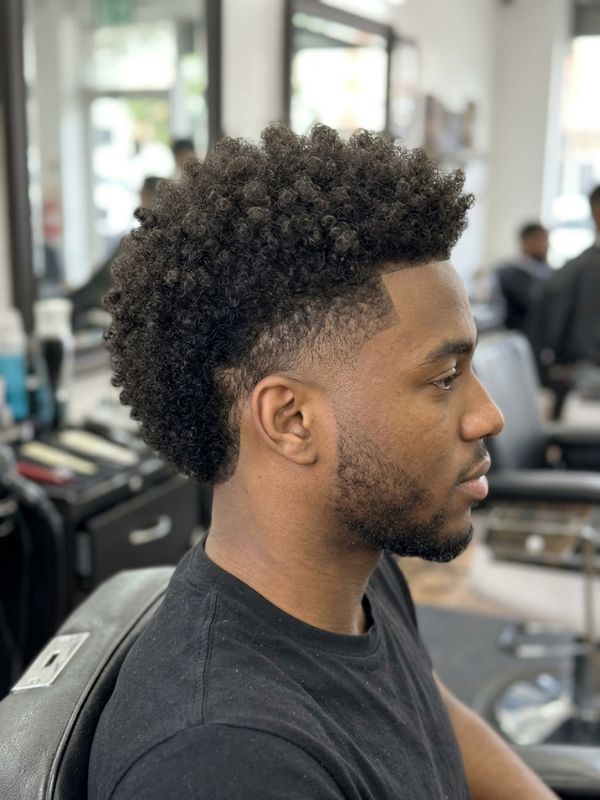
The top is shaped into an even, rounded outline rather than pushed in one direction. It works across many densities and needs little more than a light cream and finger shaping.
Which options preserve length and make a bolder statement?
These use a higher arc, stronger contrast, or deliberate length. A rear-view photo matters most here because the back silhouette carries the look.
High burst fade with volume
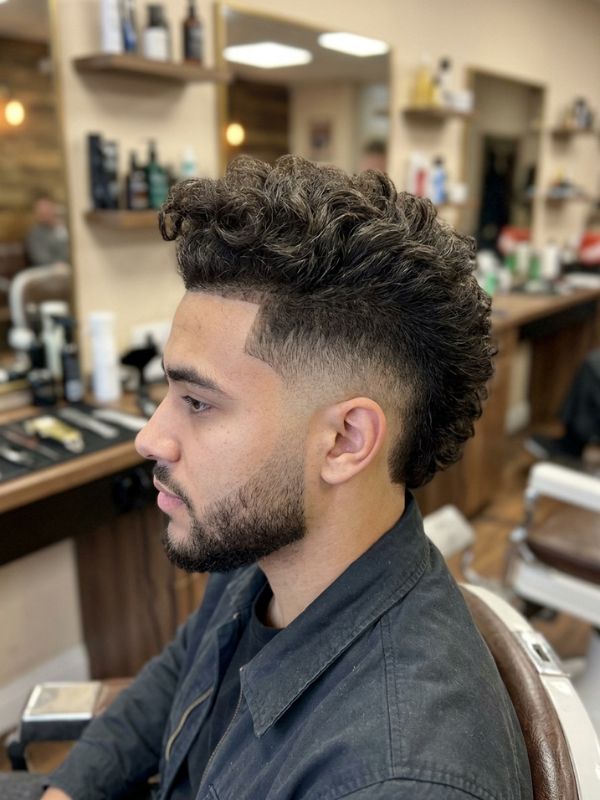
The arc starts higher to remove side weight, which makes the volume on top stand out. Expect regrowth to show sooner than on a lower fade.
Curly burst-fade mullet
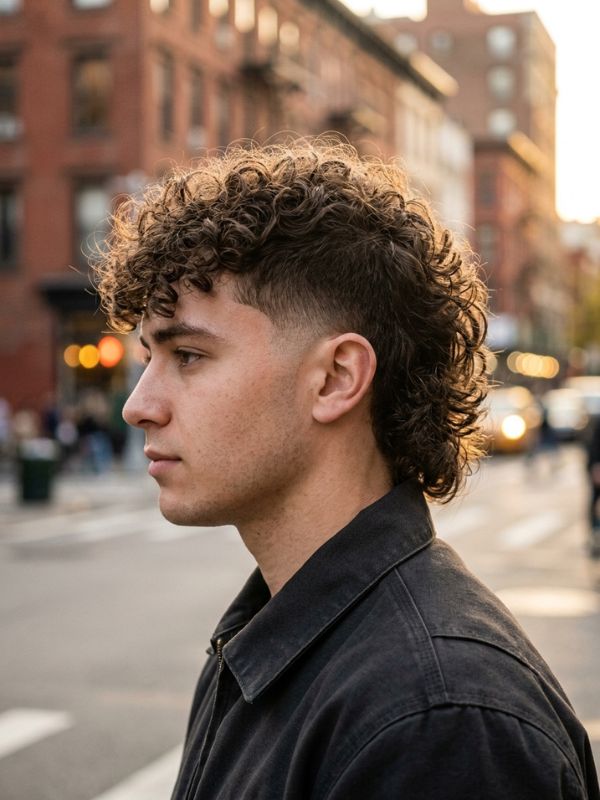
Sides are faded short while the back stays noticeably longer. The arc creates a clear break between the short sides and the longer curls behind.
Curly frohawk or mohawk
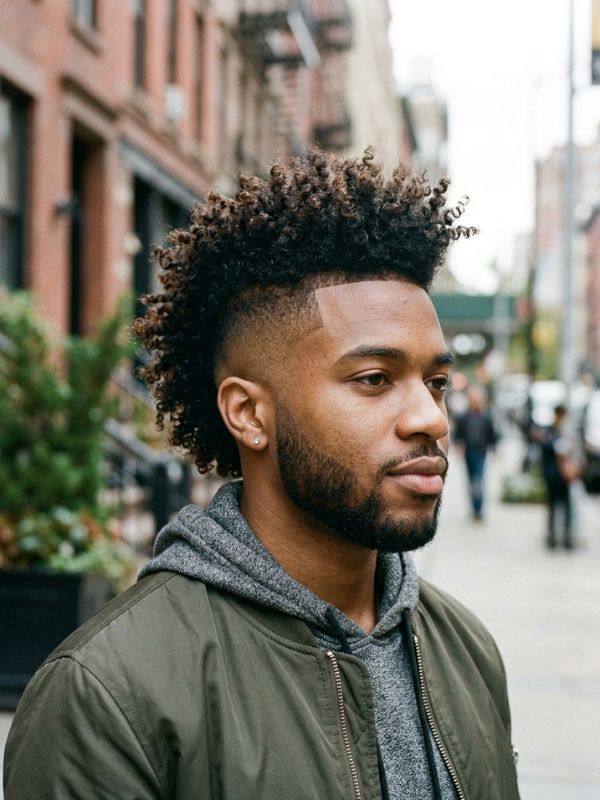
The sides are faded close and a central strip of curls is left long and lifted. It puts volume right down the middle and needs regular shaping to stay neat.
Burst fade vs drop fade vs taper: what is the difference?
A burst fade makes a rounded arc around the ear. A drop fade curves down toward the nape. A taper keeps more length and limits shortening to the edges. Barbers use these terms slightly differently, so a photo always helps.
| Feature | Burst fade | Drop fade | Taper |
| Fade path | Arc around and behind the ear | Curve that drops toward the nape | Graduation at the edges only |
| Contrast | Sharp but localized | Moderate to high | Soft |
| Back treatment | Blends into a shorter or natural back | Line continues into the back | Neckline gently graduated |
| Grow-out | Arc softens at the edges | Line blurs along its length | Barely visible line |
Skin, zero, and shadow describe the finish. They can be paired with any of the three shapes, so confirm shape and finish separately.
How do you ask your barber for a curly burst fade?
Give your barber specific details, not just a style name. Ask them to check your curls dry and unstretched, since a guard number cannot tell them how far your hair springs up as it dries.
Which six decisions should you make first?
- Height: low, mid, or high.
- Finish: skin, zero, shadow, or a short guard.
- Arc: tight and close, or wider and more gradual.
- Side weight: how much hair stays above the fade.
- Top: the dry length and shape you want, not just a guard number.
- Back and neckline: natural, tapered, or longer.
What should your barber brief and reference photos include?
Bring a side photo and a rear photo. Say what to keep as clearly as what to remove, and mention how your hair shrinks and grows. Point out anything in the photo you do not want copied, such as a beard line or a different curl pattern.
Use this script and swap in your choices:
“I would like a [low/mid/high] burst fade that curves around my ear, finished at [skin/zero/shadow]. Please leave [amount] of weight above the arc, keep the top close to [desired result], and leave the back [natural/tapered/longer]. My curls shrink a lot when dry, so please plan for that.”
When unsure, ask the barber to start longer. Length can always come off later.
How should you style a curly burst fade?
Style on damp hair. Mist with water, work in a small amount of leave-in conditioner or curl cream, shape with your hands, and let the curls dry with minimal touching. Use less product if your curls are fine or low density, since heavy products can weigh them down.
What is the fastest daily styling routine?
- Mist your curls until they loosen and reform.
- Apply a small amount of leave-in or curl cream through the lengths.
- Scrunch or finger-coil to shape the curl pattern.
- Position the top or fringe where you want it.
- Air-dry, or diffuse on low heat without brushing.
Want more height instead of definition? Ask your barber about a blowout-style finish for the top.
How do you care for curly hair between cuts?
Protect moisture, limit rough handling, and keep your scalp clean. The American Academy of Dermatology notes that thick curly hair does not need washing as often as straight hair, but it still needs regular cleansing for scalp health. Adjust the schedule to your scalp, product use, and activity level.
What should wash-day care include?
- Clarify when needed: use a clarifying shampoo now and then if you build up gels, creams, or pomades.
- Condition the lengths: apply conditioner through all your curls, not only the ends.
- Detangle wet: work through knots with fingers or a wide-tooth comb while the hair is conditioned.
- Seal moisture: finish with a leave-in conditioner or light oil while the hair is still damp.
- Clean the fade area: wash the skin around the ears and nape gently so pores stay clear.
How should you protect curls overnight?
Reduce friction while you sleep. A satin or silk pillowcase or bonnet helps. If your hair is long enough, a loose ponytail on top of the head (often called a pineapple) or a loose braid keeps the pattern from flattening. Very short curls usually just need a light misting in the morning.
How often should you refresh a curly burst fade?
There is no single schedule. As a rough guide, many barbers see crisp skin-finish fades looking tired after about two to three weeks, while softer shadow or low versions can last a little longer. Your growth rate, finish, and tolerance for a fuzzy edge decide the real answer.
What signals matter more than a fixed calendar?
Book a refresh when you notice:
- The arc no longer reads as a clean curve
- Contrast with the top has faded
- The neckline has drifted from its shape
- The top feels unbalanced or heavy
- Styling takes longer than it used to
Note that cleaning up the fade and reshaping the curls on top are separate jobs. You may need the first more often than the second.
How do you grow out a curly burst fade cleanly?
Soften the contrast in stages instead of letting the arc grow in unevenly.
- Move from a skin finish to a shadow finish.
- Bring a high arc down to mid, then low.
- Stop widening the arc so side weight can rebuild.
- Keep the top shaped so length stays balanced.
- Choose a landing style, such as a taper, a curly crop, a soft mullet, or an all-over scissor cut.
Book short trims during the process, even if you are not chasing a sharp fade. They prevent a lopsided shape.
What can go wrong, and how do you fix it?
Most problems come from four causes: an arc taken too high or wide, too little side weight, shrinkage that was not planned for, or product that is too heavy for your density. Describe the symptom to your barber instead of calling the whole cut wrong.
Which haircut or styling mistakes are most common?
| Mistake | Likely result | Fix |
| Arc cut too high or wide | Top looks disconnected from the sides | Let it grow, then request a lower arc next time |
| Ignoring crown or cowlick | Patchy blend or sticking-out curls | Ask the barber to follow your growth direction |
| Cutting stretched curls | Top springs up much shorter than expected | Ask for a dry-hair check before cutting |
| Too much product | Limp, greasy curls | Use a smaller amount and clarify regularly |
| Brushing dry curls | Frizz and breakage | Detangle wet with conditioner and a wide-tooth comb |
When should irritation or bumps change the plan?
Occasional razor bumps can happen after close clipping. But persistent, painful, or scarring bumps at the nape are not normal. Close shaving and very short cuts can worsen a condition such as acne keloidalis nuchae. If bumps keep returning, see a doctor or dermatologist and ask your barber to leave the neckline slightly longer in the meantime.
What are the best alternatives to a curly burst fade?
Pick an alternative based on what you want to change about the burst fade.
| Alternative | Best reason to choose it | Contrast |
| Low taper | You want tidy, not dramatic | Low |
| Drop fade | You want the curve to continue around the back | Moderate to high |
| Temple fade | You want to keep nearly all your side length | Lowest |
| Scissor taper | You want the softest grow-out | Low |
Curly burst fade FAQs
Does a burst fade have to go down to skin?
No. Burst describes the curved shape, not the finish. You can pair it with skin, zero, shadow, or a short guard.
How long should curly hair be on top for a burst fade?
There is no fixed length. Leave enough for your curls to form the shape you want after they shrink, and ask your barber to judge it dry.
Can a burst fade work on both loose waves and tight coils?
Yes. Height, side weight, and top length are adjusted to match your density and pattern.
Is a curly burst fade professional enough for work or school?
Often yes, especially a low or shadow version with a neat neckline. Check your dress code first.
Can fine or low-density curls wear a burst fade?
Yes. Keep enough weight above the arc and avoid going too high or wide.
Does a burst fade have to come with a mullet?
No. A mullet is only one option, and the same fade works with short curls, a fringe, or a frohawk.
How often should I get a burst fade refreshed?
Most people refresh every two to four weeks, depending on finish and how crisp the arc needs to look.
Which burst fade is best for first-timers?
A low burst fade with a shadow finish is the easiest to wear and grow out.
Conclusion
A curly burst fade works best when you decide three things first: arc height, shortest finish, and how much length stays on top and at the back. Those choices matter more than the style name, because the same label can mean very different cuts in the chair.
Bring side and rear photos, mention how your curls shrink as they dry, and book a refresh when the arc loses its shape. Start low if you are unsure. With a clear brief and steady curl care, this cut looks sharp now and grows out gracefully.