

![Taper Low Burst Fade: Styles, Barber Tips, and a Complete Guide Getting a haircut request wrong at the barbershop is more common than most guys admit. You say "fade," the barber hears something completely different, and you leave with a cut that's too high, too harsh, or missing the shape you actually wanted. The taper low burst fade fixes that problem by being specific: a low, gradual taper on the sides paired with a curved burst that wraps around the ear. This guide breaks down exactly what the cut is, who it flatters, which variations are worth requesting, and how to talk to your barber so you get it right the first time. We'll also cover upkeep, common mistakes, and how it stacks up against a blowout taper. What a taper low burst fade is A taper low burst fade is really two ideas working together. The "taper" part refers to how the hair gradually shortens along the sides and neckline instead of dropping straight to skin. The "low" part tells the barber where that shortening should begin, close to the ears and nape rather than up near the temples, which keeps more density on the sides. The "burst" is what makes this cut recognizable. Rather than fading in a straight vertical line down the side of the head, the blend curves around the ear in a half-moon shape, tightest at the ear and fanning outward. That curved detail is what separates a burst fade from a standard fade or a plain taper. Put together, you get a cut that's subtle enough for daily life but has a distinct, rounded line around the ear that catches attention without shouting. It reads clean from the front and detailed from the side, which is exactly why barbers describe it as a low-key cut with a bit of personality built in. Element What it controls Typical result Taper Gradual shortening on sides/neckline Soft, blended transition, no harsh skin lines Low Where the fade begins More hair kept on sides, closer to ears Burst Shape of the fade line Curved, half-moon detail around the ear Taper vs low fade vs burst fade These three words get used interchangeably at the barbershop, and that's exactly how mismatched haircuts happen. Each one describes a different part of the cut, not a whole style on its own. Taper A taper is the mildest form of fading. Hair shortens gradually toward the neckline and ears but never reaches bare skin. It's the safest, most professional-looking option, and it's often the foundation other details, like a burst, get built on top of. Low fade "Low" is purely about placement. A low fade starts its blend near the ear and neckline instead of higher up by the temple or crown. This keeps more length on the sides overall and tends to grow out more gracefully than a mid or high fade, meaning fewer trips back to the chair. Burst fade The burst describes the shape of the fade line, not its height. Instead of running straight, it arcs around the ear like a sunburst. This shape pairs especially well with mullets, fringes, and textured tops, since the curve moves with the hair rather than cutting against it. Term Refers to Where it shows Best paired with Taper Gradient/blend style Sides and neckline Any cut, especially conservative looks Low fade Starting height of fade Near ears/nape Guys wanting subtle contrast Burst fade Shape of the fade line Curves around the ear Mullets, fringes, curly or wavy tops Who a taper low burst fade suits Because the fade sits low and the burst rounds off sharp lines, this cut adapts to more face shapes and hair types than a high or skin fade generally does. Face shapes Round faces, Keep length and volume on top to add vertical lift, since that's what balances roundness more than the fade line itself. Square faces, This shape works especially well here. The curved burst softens a strong jawline instead of emphasizing it. Oval and oblong faces, Nearly foolproof. Any top length works because there's no specific proportion to correct. Heart-shaped faces, Benefits from a little extra volume on top, which balances a narrower chin against a wider forehead. Hair types Straight hair, Shows the curved line crisply, especially with a short or textured top. Wavy hair, Blends naturally with the burst shape; minimal product needed to look intentional. Curly hair, Arguably the best match. The rounded fade follows the curl pattern instead of fighting it, and curls on top hide regrowth well. Coily hair, Works nicely too, and keeping the fade low means less exposed skin, which simplifies upkeep between visits. Best styles to ask for The fade stays fairly consistent across versions of this cut, what changes is the length and texture left on top. That choice shapes the entire personality of the haircut. Textured crop, The most requested version. A slightly tousled, lived-in finish that suits nearly every face shape. Short top, The lowest-maintenance option. Minimal styling, and the curved burst still does the visual work. Curls left long, A low-effort combo for curly hair, since curls naturally disguise regrowth. 360 waves, The low fade keeps the sides tidy while the wave pattern stays the focal point up top. Burst fade mullet, A bolder choice with length retained at the back and a clean curved line at the sides. Forward fringe, Softer and more youthful, though it needs slightly more frequent trims to stay sharp. How to ask your barber for it Even a clear mental picture can get lost in translation at the chair. Barbers work quickly, and vague requests almost always default to whatever they cut most often. A script that works Try something like: "I want a low taper fade with a burst around the ear, not a straight line. Keep the fade close to my neckline and ears, and leave [your desired length] on top." Swap the bracketed part for "textured," "short," "curly," or "a bit longer for a fringe," depending on the style you want. What to show Photos communicate far more than words. Bring a reference that clearly shows: The curve of the burst around the ear How low the fade sits The length and texture on top Side and back-angle photos matter just as much as front-facing ones, since the burst detail is hard to judge head-on. Also mention your hair type, curly and straight hair are cut differently to achieve the same curved line. Keeping a taper low burst fade sharp The curved shape is precise, which means it's also the first thing to blur as hair grows back in. Touch-up timeline Fade tightness Recommended touch-up window Tight, close burst Every 2–3 weeks Softer, longer taper Every 3–4 weeks Longer top (mullet/fringe/curls) Can stretch slightly longer since length hides regrowth Neckline and sideburn cleanup Between visits, a light trimmer touch-up can extend the sharp look: Use a close guard on the neckline, following your natural hairline rather than cutting a harsh straight edge. Trim sideburns in small increments, it's easy to take off too much at once, and uneven sideburns throw off the whole cut. Mistakes that ruin the cut Most problems with this haircut happen at the chair, not at home. Letting the fade creep higher, A low fade can slowly become a mid or high fade if you don't confirm placement with your barber each visit. Over-thinning around the ear, The burst needs enough hair left around the ear to hold its curve. Cut too close, and it flattens into a regular fade. Poor blending at the back, A visible line where the burst meets the rest of the hair usually shows up a week or two after the cut, once hair starts growing back unevenly. Styling it at home This cut is designed to need very little daily effort. Matte clay, Best for textured or short tops; adds definition without shine. Light pomade, Good for a bit of controlled sheen on wavy styles. Texture powder, Useful for fine or straight hair that tends to fall flat, adding grip at the roots. A quick routine: apply product to damp, towel-dried hair, work it through with your fingers rather than a comb, and either lift at the roots for height or press down for a sleeker look. Most barbers recommend keeping this style slightly textured and dry rather than glossy, heavy shine tends to make the curved fade look stiff. Taper low burst fade vs blowout taper These two styles get compared often, but the difference is mostly about the top rather than the fade line itself. Feature Taper low burst fade Blowout taper Fade shape Curved burst around the ear Standard straight taper Top styling Minimal, low daily effort Requires daily blow-drying for volume Maintenance Frequent barber visits (2–4 weeks) More forgiving as it grows out Overall look Clean, defined, subtle detail Fuller, more voluminous on top If you want a cut that looks sharp with barely any daily styling, the burst fade wins. If volume and a bigger silhouette on top matter more to you, a blowout taper is the better fit, provided you're willing to style it most mornings. Is it okay for school, work, or formal settings? Yes. The low placement keeps the cut conservative enough for most dress codes, while the curved burst adds just enough character to avoid looking plain. For the most formal-friendly version, pair the fade with a short or medium-length top rather than a mullet or dramatic fringe. Final take A taper low burst fade works because it's flexible without being complicated. It suits most face shapes and hair types, adapts easily to different top styles, and looks appropriate in both casual and formal settings. The main trade-off is upkeep, the curved line needs more frequent trims than a plain taper to stay crisp. Come prepared with a clear reference photo, describe the low placement and curved shape specifically, and mention your hair type. Do that, and this cut will consistently look intentional rather than accidental. Go deeper: low taper fade guides If you're ready to explore more variations, look into related styles such as low taper fade mullets, low taper fade designs with a added part line, low taper fade options for straight or curly hair, and comparisons between low, mid, and high taper fades. Each variation builds on the same core idea, a gradual, low blend, while adjusting height, shape, or top length to fit different preferences. FAQ’S Is a burst fade the same as a taper fade? No. A taper is a general gradual blend, while a burst fade specifically curves around the ear. This cut combines both into one style. What's the difference between a burst fade and a drop fade? A drop fade curves down behind the ear toward the nape. A burst fade arcs around the ear itself and stops near the side of the neck. How often do I need a touch-up? Typically every two to four weeks, depending on how tight the fade is cut and how fast your hair grows. Does a burst fade work with curly hair? Yes, very well. The curved line follows natural curl patterns better than a straight fade would. Is this haircut good for round faces? It can be, though the real balancing effect comes from length and volume on top rather than the fade line itself. What exactly should I tell my barber? Ask for a low taper fade with a burst around the ear, specify a length for the top, and mention your hair type. Is it high maintenance? Moderately. It needs fairly regular barber visits to preserve the curve, but daily styling takes only a couple of minutes. META Discover what a taper low burst fade is, who it suits, best styles to ask for, barber tips, maintenance timeline, and styling advice, complete 2026 guide.](https://megazinestar.com/wp-content/uploads/2026/08/Taper-Low-Burst-Fade-Styles-Barber-Tips-and-a-Complete-Guide.jpg)
Getting a haircut request wrong at the barbershop is more common than most guys admit. You say “fade,” the barber hears something completely different, and you leave with a cut that’s too high, too harsh, or missing the shape you actually wanted. The taper low burst fade fixes that problem by being specific: a low, gradual taper on the sides paired with a curved burst that wraps around the ear.
This guide breaks down exactly what the cut is, who it flatters, which variations are worth requesting, and how to talk to your barber so you get it right the first time. We’ll also cover upkeep, common mistakes, and how it stacks up against a blowout taper.
What a taper low burst fade is
A taper low burst fade is really two ideas working together. The “taper” part refers to how the hair gradually shortens along the sides and neckline instead of dropping straight to skin. The “low” part tells the barber where that shortening should begin, close to the ears and nape rather than up near the temples, which keeps more density on the sides.
The “burst” is what makes this cut recognizable. Rather than fading in a straight vertical line down the side of the head, the blend curves around the ear in a half-moon shape, tightest at the ear and fanning outward. That curved detail is what separates a burst fade from a standard fade or a plain taper.
Put together, you get a cut that’s subtle enough for daily life but has a distinct, rounded line around the ear that catches attention without shouting. It reads clean from the front and detailed from the side, which is exactly why barbers describe it as a low-key cut with a bit of personality built in.
Learn more:36 Best Wolf Cut Men’s Hairstyles for Every Hair Type
| Element | What it controls | Typical result |
| Taper | Gradual shortening on sides/neckline | Soft, blended transition, no harsh skin lines |
| Low | Where the fade begins | More hair kept on sides, closer to ears |
| Burst | Shape of the fade line | Curved, half-moon detail around the ear |
Taper vs low fade vs burst fade
These three words get used interchangeably at the barbershop, and that’s exactly how mismatched haircuts happen. Each one describes a different part of the cut, not a whole style on its own.
Taper

A taper is the mildest form of fading. Hair shortens gradually toward the neckline and ears but never reaches bare skin. It’s the safest, most professional-looking option, and it’s often the foundation other details, like a burst, get built on top of.
Low fade

“Low” is purely about placement. A low fade starts its blend near the ear and neckline instead of higher up by the temple or crown. This keeps more length on the sides overall and tends to grow out more gracefully than a mid or high fade, meaning fewer trips back to the chair.
Burst fade

The burst describes the shape of the fade line, not its height. Instead of running straight, it arcs around the ear like a sunburst. This shape pairs especially well with mullets, fringes, and textured tops, since the curve moves with the hair rather than cutting against it.
| Term | Refers to | Where it shows | Best paired with |
| Taper | Gradient/blend style | Sides and neckline | Any cut, especially conservative looks |
| Low fade | Starting height of fade | Near ears/nape | Guys wanting subtle contrast |
| Burst fade | Shape of the fade line | Curves around the ear | Mullets, fringes, curly or wavy tops |
Who a taper low burst fade suits
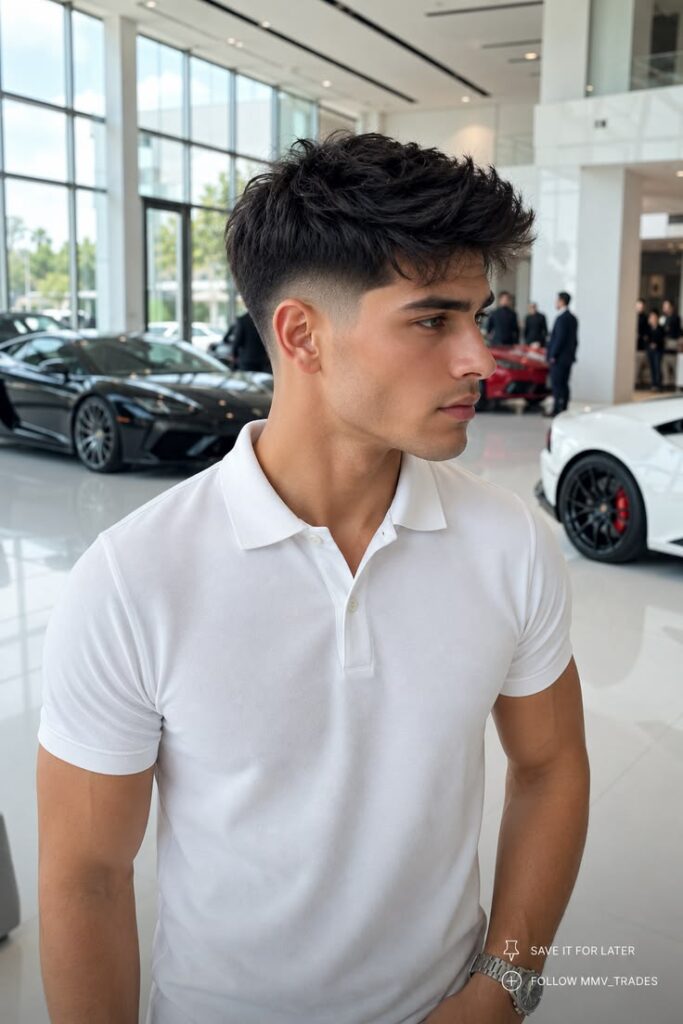
Because the fade sits low and the burst rounds off sharp lines, this cut adapts to more face shapes and hair types than a high or skin fade generally does.
Face shapes
- Round faces, Keep length and volume on top to add vertical lift, since that’s what balances roundness more than the fade line itself.
- Square faces, This shape works especially well here. The curved burst softens a strong jawline instead of emphasizing it.
- Oval and oblong faces, Nearly foolproof. Any top length works because there’s no specific proportion to correct.
- Heart-shaped faces, Benefits from a little extra volume on top, which balances a narrower chin against a wider forehead.
Hair types
- Straight hair, Shows the curved line crisply, especially with a short or textured top.
- Wavy hair, Blends naturally with the burst shape; minimal product needed to look intentional.
- Curly hair, Arguably the best match. The rounded fade follows the curl pattern instead of fighting it, and curls on top hide regrowth well.
- Coily hair, Works nicely too, and keeping the fade low means less exposed skin, which simplifies upkeep between visits.
Best styles to ask for

The fade stays fairly consistent across versions of this cut, what changes is the length and texture left on top. That choice shapes the entire personality of the haircut.
- Textured crop, The most requested version. A slightly tousled, lived-in finish that suits nearly every face shape.
- Short top, The lowest-maintenance option. Minimal styling, and the curved burst still does the visual work.
- Curls left long, A low-effort combo for curly hair, since curls naturally disguise regrowth.
- 360 waves, The low fade keeps the sides tidy while the wave pattern stays the focal point up top.
- Burst fade mullet, A bolder choice with length retained at the back and a clean curved line at the sides.
- Forward fringe, Softer and more youthful, though it needs slightly more frequent trims to stay sharp.
How to ask your barber for it
Even a clear mental picture can get lost in translation at the chair. Barbers work quickly, and vague requests almost always default to whatever they cut most often.
A script that works
Try something like: “I want a low taper fade with a burst around the ear, not a straight line. Keep the fade close to my neckline and ears, and leave [your desired length] on top.”
Swap the bracketed part for “textured,” “short,” “curly,” or “a bit longer for a fringe,” depending on the style you want.
What to show
Photos communicate far more than words. Bring a reference that clearly shows:
- The curve of the burst around the ear
- How low the fade sits
- The length and texture on top
Side and back-angle photos matter just as much as front-facing ones, since the burst detail is hard to judge head-on. Also mention your hair type, curly and straight hair are cut differently to achieve the same curved line.
Keeping a taper low burst fade sharp

The curved shape is precise, which means it’s also the first thing to blur as hair grows back in.
Touch-up timeline
| Fade tightness | Recommended touch-up window |
| Tight, close burst | Every 2–3 weeks |
| Softer, longer taper | Every 3–4 weeks |
| Longer top (mullet/fringe/curls) | Can stretch slightly longer since length hides regrowth |
Neckline and sideburn cleanup
Between visits, a light trimmer touch-up can extend the sharp look:
- Use a close guard on the neckline, following your natural hairline rather than cutting a harsh straight edge.
- Trim sideburns in small increments, it’s easy to take off too much at once, and uneven sideburns throw off the whole cut.
Mistakes that ruin the cut
Most problems with this haircut happen at the chair, not at home.
- Letting the fade creep higher, A low fade can slowly become a mid or high fade if you don’t confirm placement with your barber each visit.
- Over-thinning around the ear, The burst needs enough hair left around the ear to hold its curve. Cut too close, and it flattens into a regular fade.
- Poor blending at the back, A visible line where the burst meets the rest of the hair usually shows up a week or two after the cut, once hair starts growing back unevenly.
Styling it at home
This cut is designed to need very little daily effort.
- Matte clay, Best for textured or short tops; adds definition without shine.
- Light pomade, Good for a bit of controlled sheen on wavy styles.
- Texture powder, Useful for fine or straight hair that tends to fall flat, adding grip at the roots.
A quick routine: apply product to damp, towel-dried hair, work it through with your fingers rather than a comb, and either lift at the roots for height or press down for a sleeker look. Most barbers recommend keeping this style slightly textured and dry rather than glossy, heavy shine tends to make the curved fade look stiff.
Taper low burst fade vs blowout taper

These two styles get compared often, but the difference is mostly about the top rather than the fade line itself.
| Feature | Taper low burst fade | Blowout taper |
| Fade shape | Curved burst around the ear | Standard straight taper |
| Top styling | Minimal, low daily effort | Requires daily blow-drying for volume |
| Maintenance | Frequent barber visits (2–4 weeks) | More forgiving as it grows out |
| Overall look | Clean, defined, subtle detail | Fuller, more voluminous on top |
If you want a cut that looks sharp with barely any daily styling, the burst fade wins. If volume and a bigger silhouette on top matter more to you, a blowout taper is the better fit, provided you’re willing to style it most mornings.
Is it okay for school, work, or formal settings?
Yes. The low placement keeps the cut conservative enough for most dress codes, while the curved burst adds just enough character to avoid looking plain. For the most formal-friendly version, pair the fade with a short or medium-length top rather than a mullet or dramatic fringe.
Final take
A taper low burst fade works because it’s flexible without being complicated. It suits most face shapes and hair types, adapts easily to different top styles, and looks appropriate in both casual and formal settings. The main trade-off is upkeep, the curved line needs more frequent trims than a plain taper to stay crisp.
Come prepared with a clear reference photo, describe the low placement and curved shape specifically, and mention your hair type. Do that, and this cut will consistently look intentional rather than accidental.
Go deeper: low taper fade guides
If you’re ready to explore more variations, look into related styles such as low taper fade mullets, low taper fade designs with a added part line, low taper fade options for straight or curly hair, and comparisons between low, mid, and high taper fades. Each variation builds on the same core idea, a gradual, low blend, while adjusting height, shape, or top length to fit different preferences.
FAQ’S
Is a burst fade the same as a taper fade?
No. A taper is a general gradual blend, while a burst fade specifically curves around the ear. This cut combines both into one style.
What’s the difference between a burst fade and a drop fade?
A drop fade curves down behind the ear toward the nape. A burst fade arcs around the ear itself and stops near the side of the neck.
How often do I need a touch-up?
Typically every two to four weeks, depending on how tight the fade is cut and how fast your hair grows.
Does a burst fade work with curly hair?
Yes, very well. The curved line follows natural curl patterns better than a straight fade would.
Is this haircut good for round faces?
It can be, though the real balancing effect comes from length and volume on top rather than the fade line itself.
What exactly should I tell my barber?
Ask for a low taper fade with a burst around the ear, specify a length for the top, and mention your hair type.
Is it high maintenance?
Moderately. It needs fairly regular barber visits to preserve the curve, but daily styling takes only a couple of minutes.