

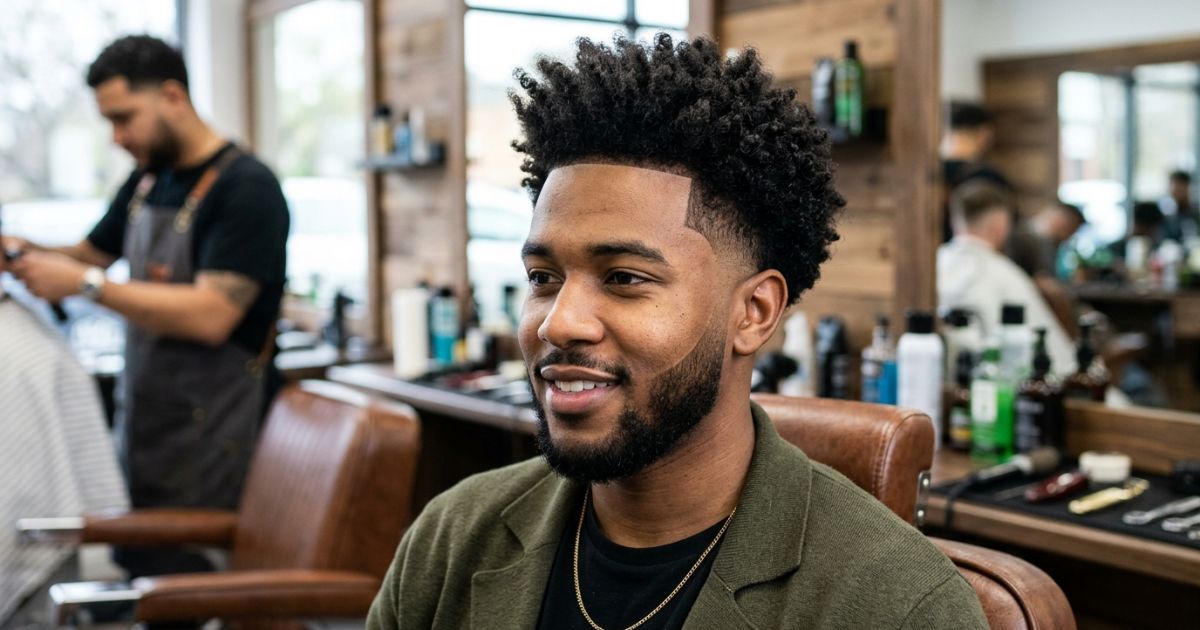
Blowout low taper fade curly hair. Go too aggressive with the clippers and the curl pattern disappears; leave things too long and the whole cut loses its shape. The blowout low taper fade solves that tension by pairing a full, rounded curly top with a fade so gradual it barely announces itself.
This guide breaks down what the cut actually involves, why curl texture responds so well to it, and how to adapt it for wavy, curly, or coily hair. You’ll also get barber-ready wording, face-shape guidance, a home styling routine, and a realistic maintenance schedule so the cut still looks sharp weeks after you leave the chair.
What is a blowout low taper fade for curly hair?
A blowout, in barbering terms, isn’t just a drying technique, it’s a haircut. It describes a rounded, voluminous top with real height, usually shaped with shears or clipper-over-comb work rather than a flat buzz. On curly and coily hair, this shape gives the texture room to coil, loop, or wave instead of getting compressed into a flat mass.
The “low taper fade” part refers to where the fade begins. Instead of starting high on the head or above the temple, a low taper starts just above the ear and around the nape, fading so gradually that there’s almost no visible line between skin and hair. It’s the most restrained fade height available, which is exactly why it pairs so naturally with dense, voluminous curls.
Combined, you get a haircut where the top stays full enough to show curl definition while the sides and back stay quiet and clean. It reads as one cohesive style rather than two mismatched halves, which is the entire point.
Blowout fade vs. skin fade vs. regular taper

These three terms get mixed up constantly, so it’s worth separating them clearly.
| Cut type | Sides and back | Top | Best suited for |
| Blowout low taper fade | Fades gradually from skin/short guard, low near ears and nape | Full, rounded, voluminous | Curly and coily hair that needs length to show pattern |
| Skin fade | Cut down to bare skin, often starting higher | Any length, often shorter | Straighter hair or clients who want maximum contrast |
| Regular taper | Light trim, minimal blending | Longer, less structured | Low-maintenance looks without a sculpted top |
A skin fade creates sharp contrast that can compete with dense curls rather than complement them. A regular taper skips the blending altogether, which is easy to maintain but doesn’t give the same polished silhouette. The blowout low taper fade sits in the middle, structured, but never harsh.
Why it works so well with curly hair
Curly and coily strands don’t behave like straight hair once clippers get involved. Curls need a certain amount of length before the pattern even becomes visible, cut a tight coil too short and it just looks like stubble instead of a defined curl. The blowout leaves that length intact on top, while the low taper removes bulk exactly where curly hair tends to get unmanageable: around the ears, at the nape, and along the sides where density and frizz both peak.
Keeping the fade low also avoids a common problem with high and skin fades on curly hair, a hard line landing right where volume is thickest, which can look like two disconnected styles stacked on top of each other. A low taper blends gradually enough that the eye moves from skin to short hair to full curl without any abrupt jump.
Density plays a role too. Thick, coarse curls carry extra weight at the sides that a basic trim never really addresses, and tapering removes that bulk without touching the shape on top. Finer curls benefit differently, since a low taper preserves more length overall, the style never looks thin the way it might under a higher, more aggressive fade.
How curl pattern affects fade placement
Every curl type takes a fade a little differently. In general, the tighter and springier the curl, the more blend room a skilled barber will leave at the sides.
| Curl type | Recommended fade height | Reasoning |
| 2A–2B (loose waves) | Very subtle low taper | Keeps focus on natural wave movement |
| 2C–3A (soft curls) | Low taper, gentle blend | Cleans up sides without flattening curl bounce |
| 3B–3C (defined curls) | Low taper, optional hard part | Removes bulk at temples, keeps crown full |
| 4A–4B (tight coils) | Low taper, slightly longer blend zone | Prevents an abrupt texture break |
| 4C (kinky coils) | Low taper, cut while stretched | Accounts for shrinkage and avoids over-cutting |
Because the sides stay short and simple, there’s less daily upkeep overall, most of the styling effort goes into the top, which is far easier to manage than fighting frizz across the entire head.
Best styles for different curl types
The same basic formula, full top, low fade, adapts differently depending on curl pattern, density, and how much shrinkage the hair has when it dries.
Loose waves and curls (type 2A–3A)
Looser textures already have natural movement, so there’s no need for dramatic height. A soft, slightly swept-forward top with a barely-there low taper gives a clean, polished look that works well in professional settings. This version is popular with clients who want a groomed appearance without visible sides pulling attention away from the top.
Defined curls (type 3B–3C)
This is where the classic rounded blowout shines. Clients with springy, well-defined curls often pair it with a hard part above the temple for extra contrast against the low fade. These curl types tend to hold their shape well after a twist-out or wash-and-go, so the top can be rounded into a dome or shaped into a slightly boxier silhouette.
Coily and kinky hair (type 4A–4C)
For tighter coils, this style is sometimes called a taper afro. Because 4A–4C hair shrinks significantly once dry, barbers typically cut it while stretched, either blown out or braided, to judge accurate length. The blend is often placed slightly higher than on looser curl types to avoid a jarring break between the fade and the full crown. A clean edge-up at the hairline finishes the look.
Learn more:Long hair low taper fade: styles, face shapes, and upkeep that actually last
How to ask your barber for it
Miscommunication is the number one reason this cut goes wrong, since both “blowout” and “taper” get used loosely across different shops. Describe the top and the fade as two separate requests rather than assuming your barber will connect the dots automatically.
A clear way to phrase it:
“I want a blowout on top, full and rounded, with a low taper fade on the sides and back. Keep the fade low, not a skin fade.”
Beyond the basic request, a few extra details help a lot:
- Describe your curl pattern in plain language if you don’t know the classification, “tight coils that shrink a lot,” or “loose waves,” gives the barber a real starting point.
- Ask for shears on top if your curls are looser or finer, since repeated clipper passes can shred delicate curl patterns.
- Mention a hard part upfront if you want one, it’s a separate request from the fade itself.
- Bring a reference photo. Verbal descriptions of curl height and fade placement vary wildly from person to person.
Choosing the right version for your face shape
The low taper fade is forgiving by nature, mostly because it skips the harsh geometry that comes with high and skin fades. Still, small adjustments to height and roundness on top can make the cut work better with your bone structure.
| Face shape | Adjustment to make | Why it helps |
| Round | Build height, keep sides tighter | Adds visual length, breaks up roundness |
| Square | Slightly rounded top | Softens a strong jawline and broad forehead |
| Oval | Minimal adjustment needed | Most proportions already look balanced |
| Diamond / heart | Fuller sides, slightly less height | Softens width at cheekbones or forehead |
Across every face shape, the fade itself rarely needs to change dramatically, the real customization happens in how tall and how round the top is left.
How to style it at home
Styling a blowout low taper fade day to day is simpler than it looks once you settle into a routine.
- Start with clean, conditioned hair. A sulfate-free shampoo or co-wash keeps natural oils intact.
- Detangle while wet, working from ends to roots with a wide-tooth comb or fingers, detangling dry curls just breaks the pattern.
- Apply a leave-in or curl cream to damp hair, focusing on the crown where the shape matters most.
- Diffuse on low or medium heat, cupping sections and pushing upward toward the scalp to build volume rather than flatten it.
- Shape the crown while still slightly damp, then leave it alone, overworking wet curls creates frizz.
Products, by the job they do
You don’t need a full shelf of products, just something for each of three jobs: volume, definition, and frizz control.
| Product | Job it does | Best for |
| Mousse or root-lift spray | Builds volume at the crown | All curl types before diffusing |
| Curl cream or custard | Defines curl without stiffness | 3B–4C patterns needing shape |
| Leave-in conditioner | Fights frizz, adds moisture | Dry or coarse curl types |
| Light oil (argan, jojoba) | Smooths flyaways on top | Finishing touch, not root application |
A satin or silk pillowcase, plus a light mid-week refresh with water and leave-in, keeps the style going between wash days.
Keeping the fade sharp and curls fresh
Getting the cut right is only half the equation, keeping it looking intentional between visits is where most people either succeed or slip.
- Book fade touch-ups every two to three weeks. Hair around the ears and nape grows in faster than it looks, even while the top still appears full.
- Trim the top only every six to eight weeks. Over-trimming the crown too often slowly shrinks the volume the whole cut depends on.
- Protect curls at night. Cotton pillowcases pull moisture from hair and create friction; satin or silk fabric prevents both frizz and flattening.
- Wash weekly to prevent buildup. Layering product daily without a proper wash leaves curls greasy instead of defined.
- Rinse after sweating. A quick water rinse and a touch of fresh leave-in keeps definition intact after workouts.
How it compares: low fade, mid taper, and burst fade
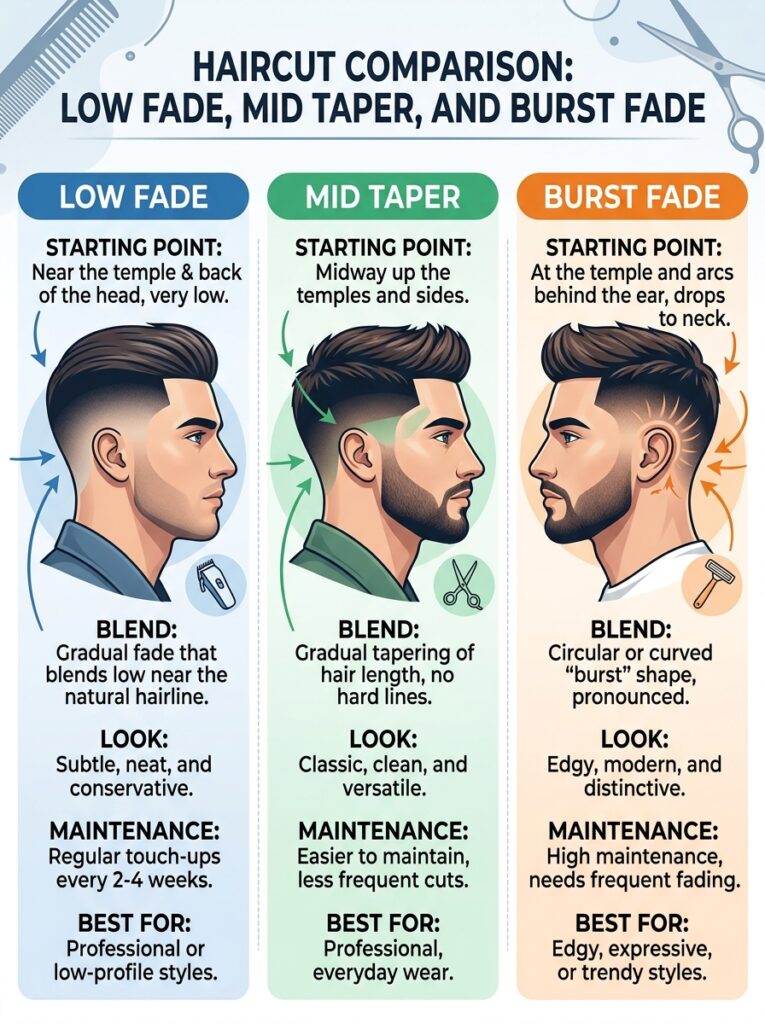
Shop menus often list these fade styles side by side with little explanation, so here’s how they actually differ.
| Fade style | Where the blend starts | Best paired with |
| Low taper fade | Near the ear and nape, very gradual | Rounded blowout tops, dense curls |
| Standard low fade | Near the ear and nape | Shorter, less styled tops |
| Mid taper fade | Mid-side of the head, more contrast | Shorter curls, straighter textures |
| Burst fade | Curves around the ear only | Fringes, fauxhawks |
For curly and coily hair specifically, the low taper remains the most forgiving option. It avoids sharp contrast against dense volume, requires less frequent upkeep than a mid taper, and doesn’t localize attention the way a burst fade does.
Frequently asked questions
Does a low taper fade work on very tight, coily hair?
Yes, it’s often the most flattering fade option for coily hair since it blends gradually instead of creating a harsh line against dense volume.
How often does the fade need to be touched up?
Every two to three weeks for the sides and nape, though the top can typically go six to eight weeks between trims.
Will diffusing damage my curls?
Not if you use low or medium heat with a leave-in product. Frequent high heat without any protection is what causes long-term dryness.
Can this style work with fine hair or looser waves?
Yes, it just calls for a softer, less rounded top and a barely noticeable fade rather than dramatic height.
What’s the actual difference between a “blowout” and just blow-drying curly hair?
A blowout is the haircut itself, the rounded, voluminous shape. Blow-drying is simply the technique used to style it afterward.
Is this cut appropriate for work or formal settings?
Generally, yes. Because the fade stays low and understated, it reads as polished while still showcasing natural curl texture.
Conclusion
The blowout low taper fade earns its popularity because it never forces curly hair to choose between structure and authenticity. It keeps enough length on top for real curl definition while the low fade quietly cleans up the sides without ever looking harsh or overdone.
Match the top’s height and roundness to your curl pattern and face shape, communicate clearly with your barber, and stay consistent with nighttime protection and trims. Done right, it’s one of the most reliable ways to make curly hair look deliberate, groomed, and completely your own.