

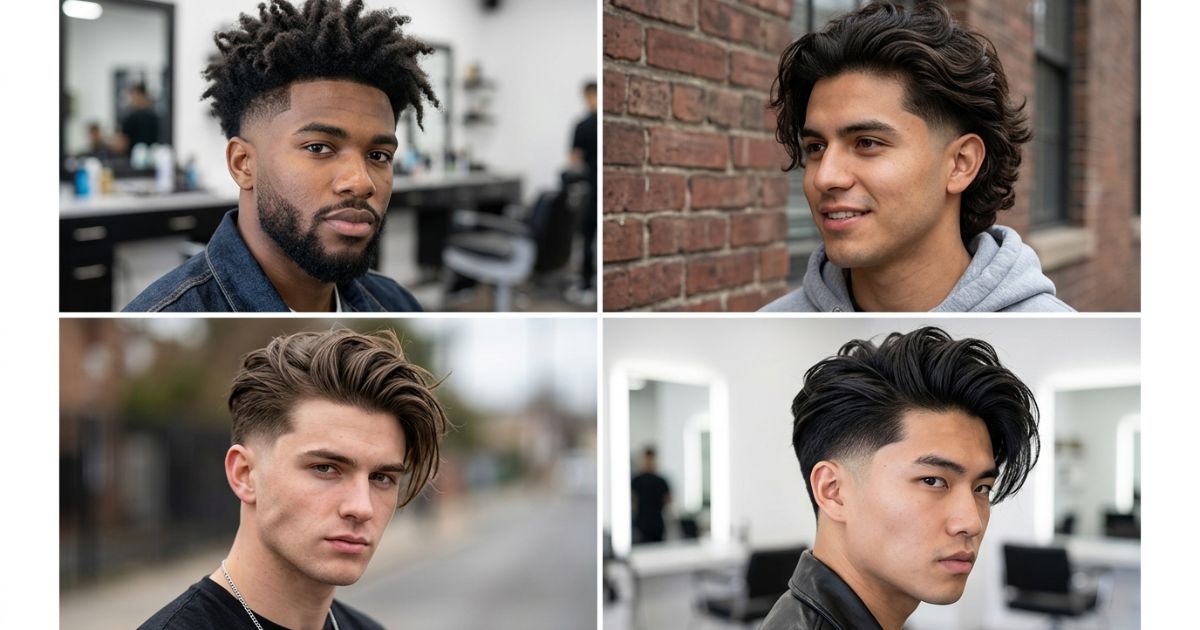
A long hair low taper fade is one of the few men’s haircuts that looks sharp on Monday morning and still looks intentional five weeks later. It keeps length on top for styling freedom while the low fade quietly cleans up the sides, so the cut never fights your face shape or your schedule.
This guide breaks down what the cut actually is, how it differs from a mid or high fade, the best styling routes for straight, wavy, and curly hair, which face shapes it flatters, and exactly what to tell your barber so you don’t leave the chair disappointed.
What is a long hair low taper fade?
A long hair low taper fade keeps noticeable length on top, usually two inches or more, while the sides and back shrink gradually into a close blend that starts low, near the ear line and the nape of the neck. “Taper” refers to the gradual shortening of the hair; “low” tells the barber exactly where that shortening should begin.
Because the blend sits so close to the hairline, most of the head keeps its natural length, and only a narrow band near the bottom does the tidying up. That’s why the cut reads as neat rather than shaved: there’s no harsh line jumping out at eye level, just a soft transition that lets the length on top take center stage.
Two things make it different from other long-on-top cuts:
- The taper never goes down to bare skin, there’s always a whisper of hair left, even at the shortest point.
- The fade line sits low enough that it grows out slowly and doesn’t leave an obvious gap between visits.
Low taper vs. mid and high fade
The placement of the blend is what changes the entire personality of the haircut, even though the technique behind it is the same.
| Fade type | Where the blend starts | Overall vibe | Best for |
| Low taper | Just above the ears, near the hairline | Subtle, low-key, office-friendly | Conservative workplaces, first-time fade wearers |
| Mid taper | Around temple height | Noticeable but balanced | Everyday wear with a bit more edge |
| High taper/fade | Near or above the temple, sometimes to the crown | Bold, high-contrast | Statement looks, streetwear-inspired styles |
A low taper is the safest starting point if you’ve never had a fade before, since it’s easy to raise the blend line at your next visit but much harder to grow a high fade back down. If in doubt, start low and adjust from there.
How long does “long” actually need to be?
There’s no fixed rule, but the length you keep on top determines which styles are even possible.
| Top length | What it allows |
| 2–3 inches | Textured crops, light comb-overs, slight movement |
| 3–5 inches | Slicked-back looks, defined side parts, quiffs |
| 5+ inches | Curtains, man buns, half-up styles, mullet-inspired looks |
The rule of thumb: the longer the top, the more the finished look depends on daily styling rather than the haircut holding its own shape.
Why the long hair low taper fade is everywhere right now
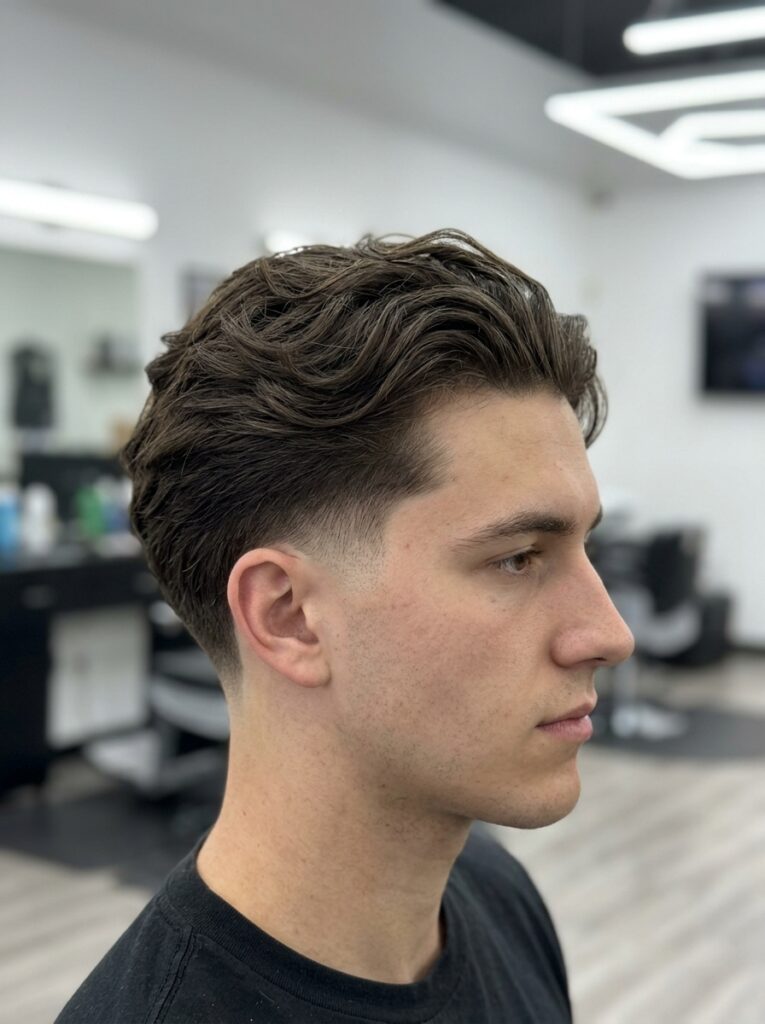
A few practical reasons explain the surge in popularity beyond it simply looking good in photos.
- It’s versatile without being loud. A high fade makes a statement whether you want it to or not. A low taper stays quiet enough for a job interview but still has personality on a night out.
- It’s genuinely low-effort between cuts. Since the fade starts near the hairline, regrowth blends in gradually instead of leaving an obvious grown-out ring, so appointments can stretch further apart.
- It works across hair types. Straight, wavy, and curly hair all take to it differently, but none of them clash with it, which is a big reason barbers recommend it to clients who are unsure what to ask for.
- It pairs naturally with facial hair. The low blend can taper straight into a beard line instead of creating a hard, disconnected border.
- It’s forgiving on face shape. Because nearly all the visual adjustment happens on top, the cut doesn’t lock you into one silhouette the way a bald fade or a heavy buzz might.
Best styles by hair type
The fade itself barely changes from one hair type to the next, it’s the top section that needs a completely different approach depending on your texture.
Straight hair
Straight strands have the least natural grip, so styling usually leans on product for structure.
- Slicked back: Combed straight back with a firm-hold pomade; needs at least four inches to look deliberate rather than damp.
- Side-swept comb-over: A defined part with a light forward sweep, finished with a matte paste for texture instead of shine.
- Center-parted curtains: Length parted in the middle and left to fall naturally on either side for a relaxed, undone finish.
Wavy hair
Wavy hair already has built-in texture, so the goal is enhancing what’s naturally there rather than overriding it with heavy product.
- Textured quiff: Blow-dried up and back for volume, held with a light cream or fiber paste.
- Natural wave flow: Minimal product, often just a sea salt spray, left to air-dry into a relaxed, beachy shape.
- Soft side part: Finger-styled rather than combed, which keeps the wave pattern intact.
Curly hair
Curly hair needs the most consistent routine because curls lose their shape quickly once they dry out.
- Natural curls left loose: Defined with a leave-in conditioner and curl cream applied while hair is still damp.
- Defined curl set: A lightweight gel or curl custard adds hold and cuts down on frizz in humid conditions.
- Gathered top: For longer curly lengths, a small ponytail keeps hair off the face during workouts or hot weather while the fade keeps the sides tidy.
| Hair type | Ideal top length | Go-to product | Quick styling tip |
| Straight | 3–6 inches | Strong-hold pomade or matte clay | Apply a texturizing powder at the roots first for lift |
| Wavy | 3–5 inches | Sea salt spray or light cream | Air-dry whenever possible to preserve the wave pattern |
| Curly | 4–6+ inches | Leave-in conditioner and curl cream | Detangle with fingers on wet hair; skip brushing once dry |
Popular variations to try
Once the fade is settled as the foundation, the top section is where you can experiment. A handful of variations come up again and again:
- Man bun with a low taper – Practical for anyone who keeps length for the gym, climbing, or cycling; the sides stay clean while the top ties back out of the way.
- Mullet-inspired long taper – More length kept through the back and crown against tidy sides, leaning into the current retro revival.
- Two-block style – A noticeably longer top paired with a very clean, close taper; popularized through Korean men’s grooming and now widely adopted elsewhere.
- Center-parted curtains – Longer hair parted down the middle and framing the forehead on both sides; looks effortless but relies on precise cutting underneath.
- Comb-over – One of the most adaptable options, easily dressed up with a firm pomade or dressed down with a lighter matte product.
Learn more:Mid Taper Fade Curly Hair: Styles, Barber Guide, and Maintenance 2026
The taper is the constant across all of these; the top is the variable you can change from one season to the next without touching the sides.
Which face shapes suit a long hair low taper fade?
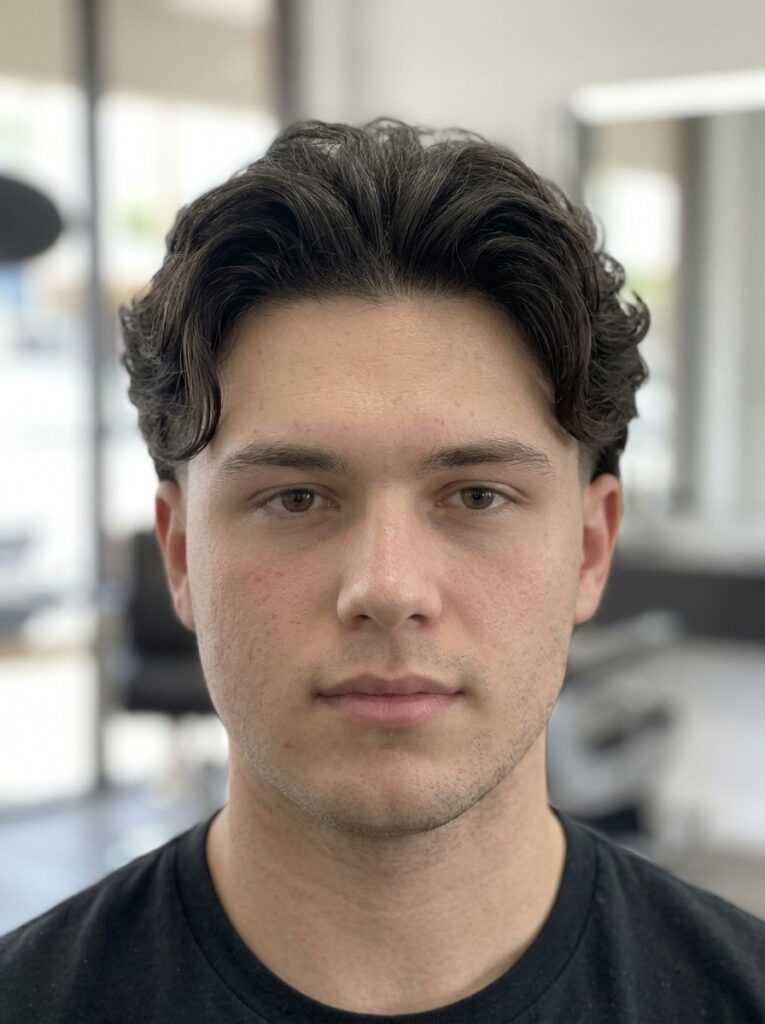
Because the low taper does so little to interfere with your overall proportions, this cut flatters a wider range of face shapes than most fades. Nearly all the adjusting happens through length, volume, and where weight sits on top.
| Face shape | What works best | What to avoid |
| Oval | Almost any variation, the safe default | Nothing in particular; low risk shape |
| Round | Height on top (quiff, swept-back) to add length | A heavy, blunt fringe sitting flat across the forehead |
| Square | Movement and texture rather than a flat, glassy slick back | Overly hard, geometric styling that emphasizes the jawline |
| Diamond | Some fringe or front volume to balance a narrower forehead/chin | Styles that pull all the hair straight back |
| Heart | A side-swept fringe to bring balance toward the jaw | Pushing the top straight back, which exposes a wider forehead |
| Rectangular/oblong | A flatter, side-parted style | Tall volume on top, which stretches an already long face |
If you’re unsure which category you fall into, a barber can usually tell within seconds by looking at your hairline, cheekbones, and jaw together.
Long hair low taper fade vs. low fade: the real difference
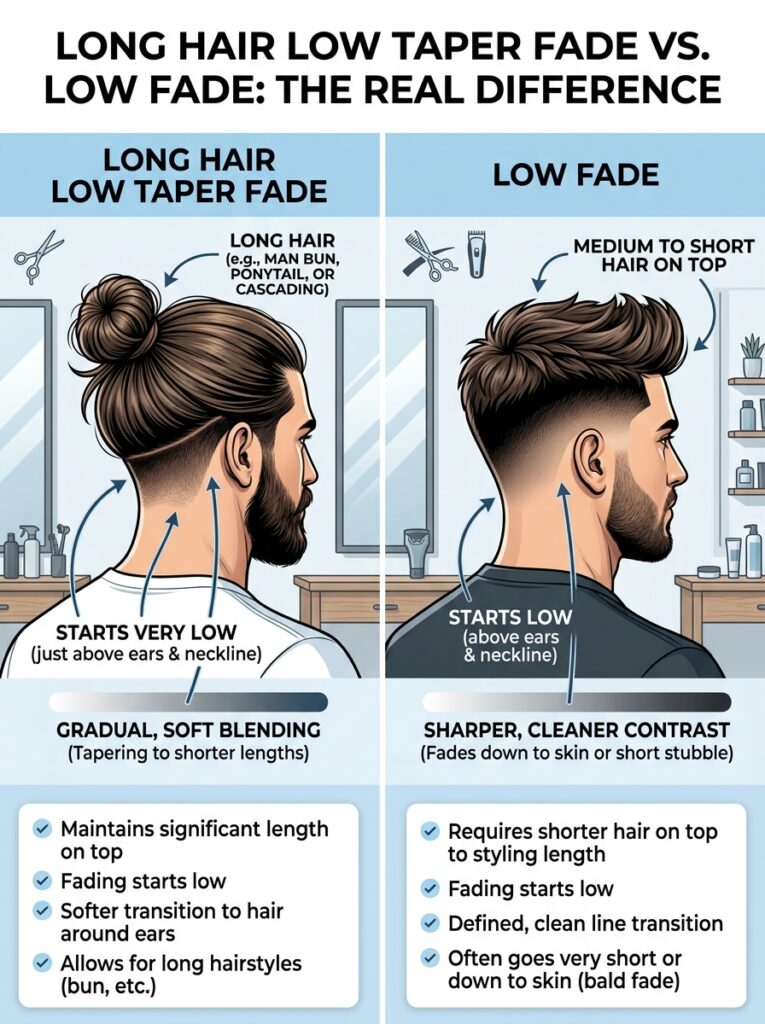
These two terms get used interchangeably, but they describe different finishes, and the distinction matters when you’re booking an appointment.
A taper never reaches bare skin. Even at its shortest point near the hairline, there’s still visible hair, typically clipped to a number one or two guard. A fade, on the other hand, blends down to the skin somewhere along the way, creating a much sharper line where hair meets scalp. Adding “low” to either term simply means that transition point sits near the ears and neckline instead of higher up the head.
| Aspect | Long hair low taper fade | Low fade (skin fade) |
| Finish at shortest point | Slight length remains, no bare skin | Blends to bare skin |
| Contrast | Soft and gradual | Sharp and defined |
| Regrowth visibility | Forgiving; blends in slowly | Noticeable sooner |
| Typical touch-up window | 4–5 weeks | 2–3 weeks |
| Overall impression | Natural, versatile | Crisp, bold |
In short: both pair beautifully with long hair on top, but a taper asks less of your maintenance schedule, while a skin fade demands more frequent upkeep to keep that clean edge from blurring.
How to ask your barber for a long hair low taper fade
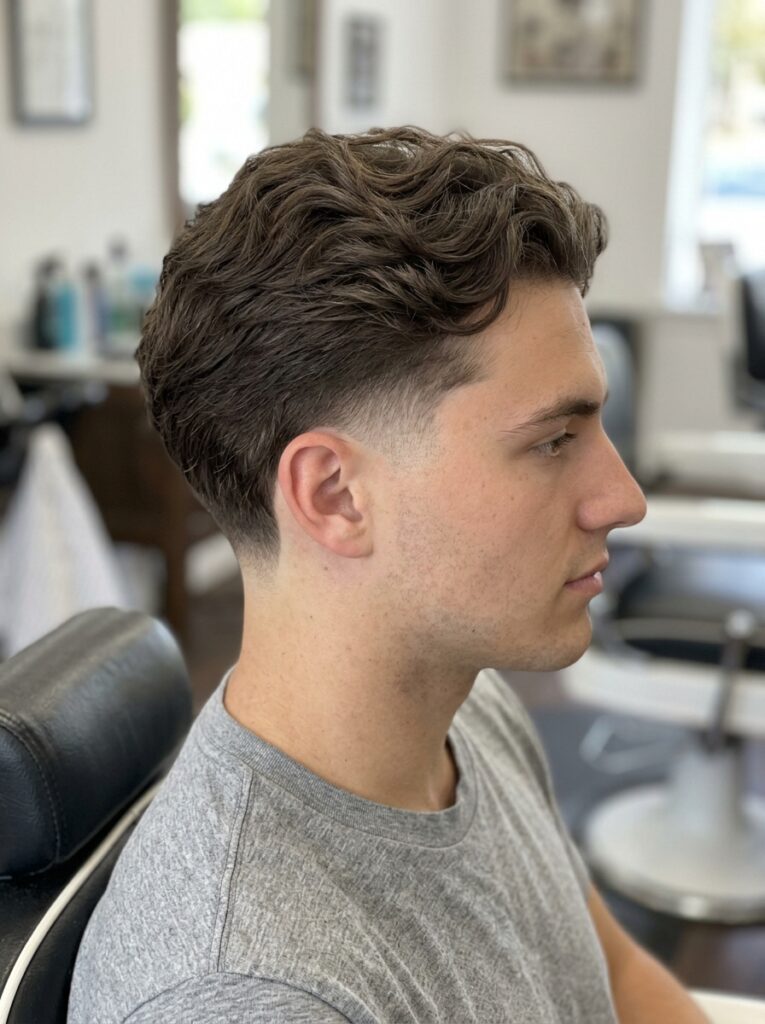
Miscommunication in the chair is the most common reason people end up with a cut they didn’t picture, barbers work off specific terms, not vague descriptions like “just clean it up.”
What to say
Try something along these lines when you sit down:
“Low taper starting near my hairline by the ears, blend down to about a number two, not a skin fade, and keep around four to five inches of length on top.”
A few things to clarify during the consultation:
- Say “low taper” specifically, not just “fade”, the word “fade” alone leaves too much open to interpretation.
- Mention a guard number if you know it (a low taper usually finishes around a two or three).
- Give an actual length or point to a reference photo instead of saying “keep it long,” which tends to come back shorter than expected.
- Flag any cowlicks or unusual growth patterns that could affect how the top sits.
- Note how much time you’re realistically willing to spend styling each morning.
A clear reference photo, ideally more than one angle, does more heavy lifting than words alone, your barber can read length, fade height, and finish from the image, while your instructions fill in the details a photo can’t show.
How to style a long hair low taper fade at home
The haircut is only half the equation; the daily routine is what keeps it looking deliberate rather than simply grown out.
- Start with hair that’s slightly damp rather than soaking wet or bone dry, product distributes more evenly this way.
- For a slicked-back or comb-over finish, warm a small amount of pomade or clay between your palms and work it in from the roots first, then smooth it back. Skipping the roots leaves the base flat by midday.
- For a textured look, a blow-dryer (with a diffuser, if your hair is wavy or curly) lifts the roots while a lighter cream locks the shape once dry.
- Curly and wavy hair generally responds better to air-drying than direct heat, work in a leave-in conditioner or curl cream while wet and let it dry naturally.
- Sleep on a silk or satin pillowcase to cut down on overnight friction, which helps the style, and curl pattern, hold longer.
- If a slick back keeps going flat or greasy by afternoon, you’re likely using too much product or applying it to dry hair. Cut the amount in half and start from a damp base.
The best products for a long hair low taper fade
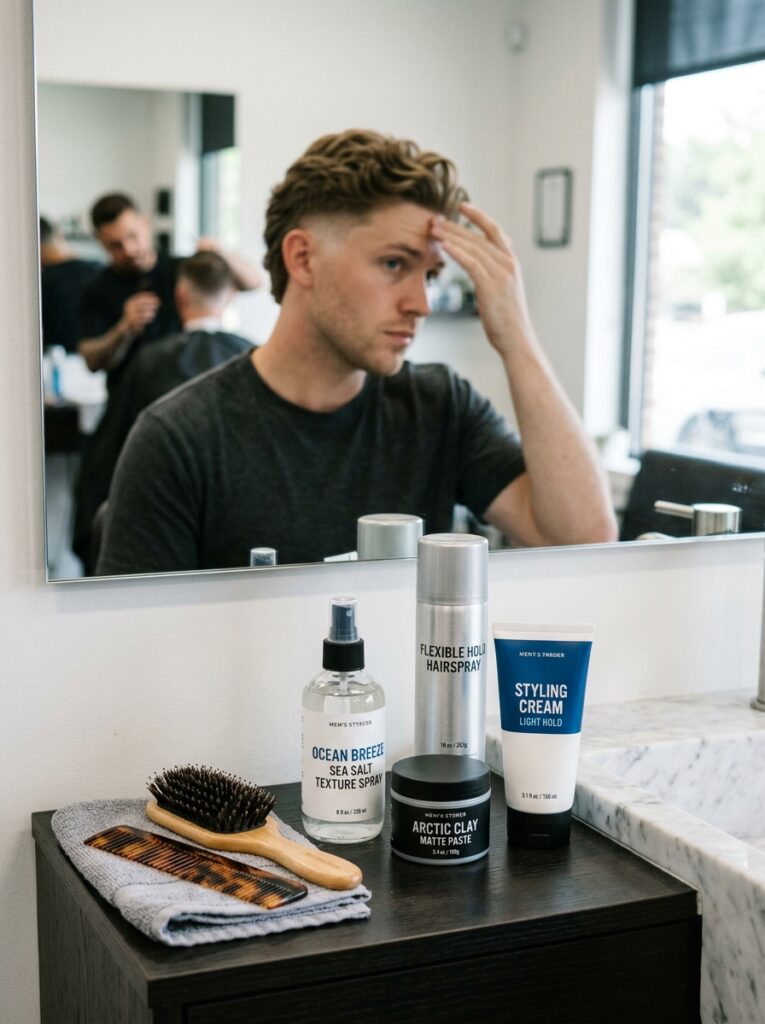
Product choice depends more on the finish you’re after than on the haircut itself.
| Product | Best for | Finish | Hold |
| Water-based pomade | Straight hair, everyday slick backs | Semi-matte to shiny | Medium |
| Oil-based pomade | Straight hair, all-day hold | High shine | Strong |
| Matte clay | Straight or wavy, textured crops | Matte | Strong |
| Styling cream | Wavy hair, natural finish | Low sheen | Light–medium |
| Sea salt spray | Wavy hair, tousled texture | Matte | Light |
| Curl cream / leave-in | Curly hair | Defined, natural | Light–medium |
| Texturizing powder | Straight, fine hair needing lift | Matte | Medium |
Most people only need two products in rotation, one for hold, one light finishing product. Buying an entire shelf up front rarely helps; pick one suited to your texture, test it for a couple of weeks, then adjust.
How often should you maintain a long hair low taper fade?
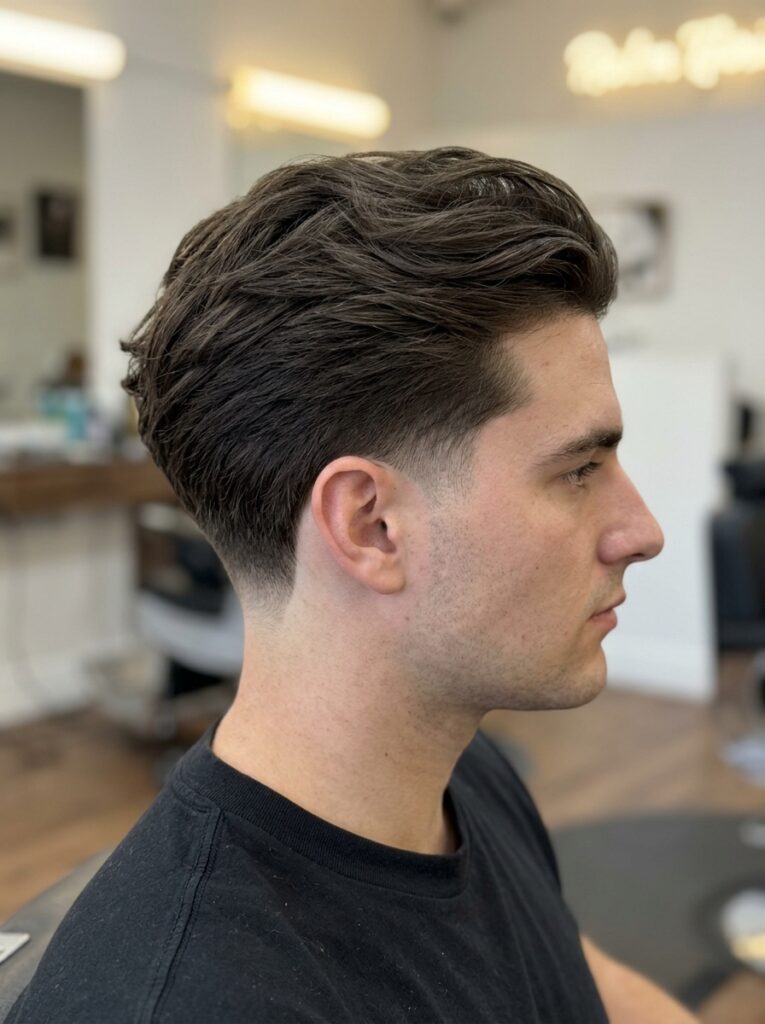
Plan on refreshing the fade every three to five weeks and lightly trimming the top every six to eight weeks, the two grow out at different rates and don’t need attention on the same schedule.
The fade line softens before the length on top becomes an issue. Since it starts low, regrowth doesn’t create the obvious “halo” that higher fades show within a couple of weeks, but it does eventually blur. Signs it’s time for a touch-up include:
- The transition between top and sides feels gradual instead of distinct.
- Hair near the ears and neckline feels noticeably bushier.
- The overall contrast between top and sides has flattened out.
Between full appointments, a home trimmer can clean up stray hairs at the neckline and around the ears without disturbing the blend itself, most barbers are fine with light touch-ups like this. Leave the actual fade line to a professional, though; an uneven blend is far more noticeable, and harder to correct, than slightly overgrown length on top.
Final takeaway
A long hair low taper fade earns its popularity because it asks very little of you between visits while still giving you room to change your look on top whenever you want. Match it to your face shape, build a styling routine suited to your hair type, and settle into a maintenance rhythm that fits how fast your hair actually grows.
Get those three details right, and the cut holds up far longer than most people expect, sharp in the chair, and still sharp weeks later.
Frequently asked questions
How long does hair need to be on top for a low taper fade to work?
About two inches is the minimum. Three to six inches gives the most flexibility for slick backs, textured crops, and comb-overs.
Does a low taper fade work well with curly hair?
Yes, curly hair suits this cut naturally, as long as the top is kept moisturized with a leave-in conditioner or curl cream.
What’s the actual difference between a taper and a skin fade?
A taper always keeps a trace of length, usually around a number one or two guard. A skin fade blends all the way down to bare skin for sharper contrast.
How often should the fade be touched up?
Most people book a refresh every three to five weeks, since a low fade line grows out more slowly than a higher one.
Can I maintain the fade myself between barber visits?
Light cleanup around the ears and neckline is fine with a home trimmer. Leave the actual blend to a professional to avoid an uneven line.
Which products work best for this haircut?
Pomade or matte clay for straight hair, sea salt spray or cream for wavy hair, and curl cream with a leave-in conditioner for curly hair.
Is a long hair low taper fade appropriate for the office?
Yes, the subtle fade and adjustable top length make it one of the more workplace-friendly cuts, since it can be slicked back for formal settings and worn loose otherwise.