

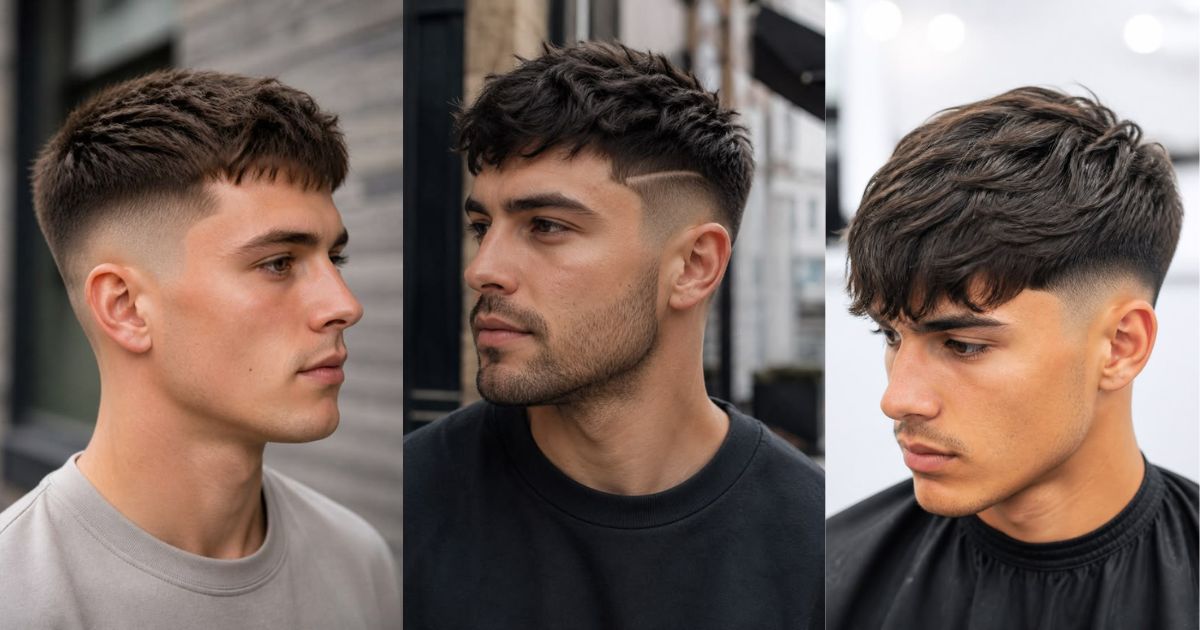
Barbershops everywhere are booked out for one specific ask right now: loose, textured hair on top that falls forward, paired with sides that fade quietly instead of shouting for attention. It’s polished but not overworked, and it’s landed on nearly every face shape and hair type without much fuss.
This guide breaks down exactly what the cut involves, who it flatters, how to brief your barber so you get it right the first time, and how to keep it looking sharp between visits without turning your morning routine into a project.
What a textured fringe with low taper fade actually is
The name describes two separate parts of the same haircut, and understanding both helps you communicate clearly in the chair.
The fringe is the section of hair on top that’s left long enough to fall forward over the forehead. “Textured” means the barber has removed weight from it using point cutting or texturizing shears, so it doesn’t sit flat or heavy. Instead, it has movement, separation, and a slightly undone finish that looks effortless rather than combed into place.
The low taper fade refers to the sides and back. A taper is a gradual shortening of hair with no hard line, and “low” means that shortening begins right at the hairline near the ears and neckline rather than higher up the head. Because the transition starts low, the contrast between long and short hair stays soft, which is part of why the cut reads as understated rather than aggressive.
| Term | What it means |
| Fringe | Longer top hair styled to fall forward over the forehead |
| Textured | Weight removed with point cutting/razoring for movement, not a flat finish |
| Taper | Gradual shortening of hair with no visible skin line |
| Low | The fade or taper starts near the ear/neckline, not partway up the head |
| Fade | Hair blended down to the skin (optional at a low taper) |
Put together, the cut gives you a natural, lived-in top with sides that stay neat without the sharp, skin-close look of a high or mid fade.
Why the cut is everywhere in 2026
A few grooming shifts have converged to push this style to the front of the queue.
- Matte is winning over shine. Wet-look gel and heavy pomade feel outdated; modern styling favors a dry, natural finish.
- Soft fades are replacing hard lines. Skin fades still exist, but a lot of men are choosing gentler blends that don’t need constant upkeep to look intentional.
- Versatility matters more than ever. One cut needs to work for the office, a night out, and a gym session, and this one moves between all three without adjustment.
- Low maintenance sells itself. Because the fade starts low, regrowth is far less noticeable than it is with a high skin fade, so trims can be spaced out further.
- It photographs well. The texture on top adds dimension in a way flat styles don’t, which matters for anyone whose hairstyle ends up on camera regularly.
It’s essentially the middle ground men have been looking for: enough personality to look current, not so much upkeep that it becomes a chore.
Who it suits
Few haircuts flatter this wide a range of people, but it does lean toward certain preferences.
Good fit if you:
- Want a modern look without a strict daily styling routine
- Like volume and texture on top but prefer slim, tidy sides
- Aren’t drawn to the exposed-skin look of high or skin fades
- Move between casual and semi-formal settings and want one cut that covers both
Worth a barber conversation first if you:
- Have very tightly coiled or Type 4 curl hair, since the fringe may need a modified approach to fall correctly
- Have extremely fine or thin hair, where too much texturizing can leave the top looking sparse rather than full
- Have a receding hairline, since fringe placement will need to work around it rather than through it
Best face shapes
The cut is adjustable enough to suit almost every face shape with small tweaks to fringe length, top volume, and where the taper sits.
Learn more:Low Taper Fade Buzz Cut: Styles, Lengths, Face Shapes, and Maintenance
| Face shape | What to adjust |
| Oval | Nearly anything works; short, medium, or longer and messier all suit the balanced proportions |
| Round | Keep fringe slightly longer with root volume for vertical lift; avoid a short, flat top |
| Square | A softer, relaxed fringe complements a strong jaw better than a blunt one; drop the taper a little lower if the jaw is wide |
| Long/oblong | Favor width over height — medium fringe length worn horizontally, taper blended a touch higher to add fullness |
| Heart | Wear the fringe forward to bring visual weight down; keep sides clean and crown volume minimal |
| Diamond | Medium fringe with soft texture at the temples softens angular cheekbones |
If you’re not sure which category you fall into, a quick rule of thumb: measure your face’s width against its length in a mirror, or ask your barber — they size up face shape constantly and can suggest tweaks on the spot.
Best hair types
The textured fringe adapts to nearly every hair type, but the technique your barber uses changes depending on what you’re working with.
Straight hair
Straight hair takes point cutting cleanly, which is exactly what gives the fringe its natural, slightly uneven fall. Without some texturizing, straight hair on top can look stiff or helmet-like, so this step matters more here than on other textures.
Wavy hair
This is often considered the easiest hair type for the cut. The natural wave does a lot of the styling work on its own, so the barber mainly focuses on removing bulk so the waves don’t clump. It tends to hold shape through the day with minimal product.
Thick hair
Thick hair delivers strong volume with this style, but bulk is the main issue. Texturizing shears are used to thin the top so the fringe moves freely instead of sitting heavy and stiff.
Fine or thin hair
Fine hair needs a lighter hand. Over-texturizing removes too much density and makes hair look thinner, not fuller. Barbers typically keep the fringe slightly longer and use root-lifting products to fake volume rather than cutting for it.
Curly hair
Curls shrink noticeably as they dry, so barbers who work with curly hair usually cut slightly longer than the intended finished length, or cut it dry to see the true shape. The natural texture does most of the styling; the goal is shaping and controlling it rather than fighting it.
| Hair type | Barber’s main focus | Styling effort |
| Straight | Point cutting for movement | Medium |
| Wavy | Managing bulk, letting waves do the work | Low |
| Thick | Thinning to reduce weight | Medium |
| Fine/thin | Minimal texturizing, root lift | Medium-high |
| Curly | Cutting longer to allow for shrinkage | Low-medium |
The main variations
There isn’t one single version of this haircut. Length on top, fringe shape, and how close to the skin the sides are cut all change the final look considerably.
- Short fringe (1.5–2.5 cm): Minimal length, subtle texture, lowest upkeep — good for hot climates or very active routines.
- Medium fringe (3–5 cm): The most commonly requested length, with enough movement to fall forward naturally while suiting the widest range of faces.
- Messy/long fringe (5 cm+): Worn longer and deliberately undone, falling unevenly across the forehead for a more off-duty feel.
- Blunt fringe: A straighter front edge with texture worked through the rest of the top — more structured, sits especially well on straight hair.
- Skin low taper: The sides fade all the way to bare skin at the ear and neckline instead of leaving a whisper of hair, sharpening the contrast while the top stays relaxed.
Each variation pairs the same basic top-and-sides formula with a different intensity, so it’s worth trying a couple of lengths over successive cuts to see which one suits your face and lifestyle best.
How to ask your barber
Vague requests lead to inconsistent results. A specific, structured brief gets you much closer to what you actually want.
- State the fringe length first. Instead of saying “medium,” say something like “around 4 cm, enough to fall forward naturally.”
- Specify the taper height. Say “low taper” and point to where your ear meets your head so there’s no ambiguity between low, mid, and high.
- Clarify skin or no skin. Tell them whether you want the sides faded to bare skin at the neckline or left with a small amount of hair.
- Ask for texture by name. Say “point cut the top for movement” rather than just “textured,” since some barbers hear “textured” and default to heavy thinning shears, which can strip volume you actually want to keep.
- Bring a reference photo. Front and side angles help the barber match length and fringe angle accurately, especially on a first visit.
A sample script you can use word for word: “Textured fringe on top, medium length, falling forward naturally. Low taper fade on the sides starting right at the ear and neckline. Point cut the top to keep movement, not thin it out.”
How to style it at home
This cut is designed to look good with minimal effort, which is one of its biggest selling points.
- Start with damp hair. Fully dry hair makes product harder to distribute evenly and can look stiff; a light mist from a spray bottle works if you’re not washing first.
- Use a small amount of product. A pea-sized amount of matte clay or cream is usually enough — you can always add more, but excess product is the fastest way to a stiff, clumped look.
- Work it in with your fingers, not a comb. Combing flattens the texture you’re trying to preserve. Push the fringe forward or to whichever side it naturally falls, then lightly scrunch through the top.
- Lift the roots if hair sits flat. A quick lift at the roots before the product sets adds noticeable fullness, especially useful on fine or straight hair.
- Air dry or blow dry on low heat. Wavy and thick hair often look best air dried. Straight or fine hair can benefit from 30–60 seconds of low-heat blow drying while pushing the fringe forward to lock in shape.
The end goal is a matte, slightly undone finish. If it looks shiny, sculpted, or overly neat, that’s usually a sign of too much product.
Best products
You don’t need an extensive routine — one or two well-chosen products cover most of what this cut needs.
| Product | Best for | Effect |
| Sea salt spray | Wavy, straight hair | Adds grip, separation, and a rough natural texture |
| Matte clay | Most hair types | Light-to-medium hold with zero shine |
| Texture powder | Fine or flat-lying hair | Adds root lift and grip without added weight |
| Lightweight cream | Wavy, thick hair | Soft, flexible hold for natural movement |
Avoid heavy gels and glossy pomades. They weigh the top down, create shine that clashes with the intended matte finish, and tend to clump the fringe into sections instead of letting it separate naturally.
Maintenance and trim schedule
The top and sides grow at different visible rates, so they need slightly different attention.
| Area | Trim frequency | Why |
| Low taper (sides/neckline) | Every 2–4 weeks | Fastest-growing, most noticeable regrowth zone |
| Fringe/top | Every 4–6 weeks | More forgiving; extra length often adds to the look |
Between full visits, a home trimmer touch-up on the neckline and sideburns can stretch how long the cut looks sharp. If the fringe starts feeling heavy or losing shape, that’s a sign the barber should point cut through the top again rather than simply trimming length. If you’re growing the cut out, ask your barber to raise the blend gradually at each visit so the sides fill in evenly instead of leaving a visible line.
Common mistakes to avoid
A handful of avoidable errors account for most disappointing results with this haircut.
- Asking for the fade too high. “Low taper” and “mid fade” get confused often; be specific and point to the exact starting height.
- Cutting the fringe too short. Under 3 cm rarely has enough length to fall forward with movement.
- Overloading on product. More product doesn’t mean more texture — usually the opposite.
- Flattening the top against the forehead. This turns a fringe into what looks like a flat cap rather than styled movement.
- Choosing the wrong variation for your hair type. A blunt fringe rarely works well on very curly hair, just as a long messy fringe can look thin on very fine hair.
- Skipping a reference photo. Words alone leave too much room for misinterpretation between you and your barber.
- Waiting too long between trims. Past five to six weeks, the taper typically needs at least a sides cleanup to keep its shape.
FAQ’s
Is a textured fringe with low taper fade good for straight hair?
Yes. Straight hair responds well to point cutting, which creates the movement and separation the fringe needs to look natural rather than flat.
How long should the fringe be?
Most versions fall between 3 and 5 cm on top, though shorter or longer options work depending on your hair type and how much styling effort you want to put in.
How often should I get a trim?
The taper and neckline usually need attention every two to four weeks, while the fringe and top can typically stretch to four to six weeks between full cuts.
Is it difficult to style every day?
No. A small amount of matte product worked through damp hair with your fingers takes under two minutes for most hair types.
Does it work with a beard?
Yes. The low, soft taper pairs well with most beard styles since it doesn’t compete for visual attention the way a high skin fade can.
Conclusion
The textured fringe with low taper fade has earned its popularity for good reason. It strikes a rare balance between relaxed and groomed, adapts across nearly every face shape and hair type, and doesn’t demand a complicated daily routine to look intentional.
Get the fringe length right for your face, match your products to your hair type, and stay ahead of the taper’s faster growth cycle. Nail those three details, and you’ll have a low-effort cut that consistently looks put together.